So, you're ready to take your English audio and make it resonate with a German-speaking audience? It's about more than just swapping words out; it’s about making your message feel native, like it was created just for them. The core process involves a few key stages: transcription, translation, and then a big decision—subtitles for authenticity or dubbing for immersion. Thankfully, modern workflows have made this entire process faster and more accessible than ever before.
Why German Audio Translation is a Game-Changer
Tapping into the German-speaking market is a massive opportunity. We're talking about connecting with over 83 million people in Germany alone, not to mention Austria and Switzerland. For creators and businesses, translating your audio from English to German isn't just a nice-to-have; it's a fundamental growth strategy. It signals a real commitment to that audience, making your content hit home way more effectively.
This isn't just a hunch; the global trends back it up. The demand for audio translation is exploding, right alongside the market for language translation devices. That market hit USD 1.21 billion in 2023 and is projected to more than double to USD 2.48 billion by 2031. You can learn more about this explosive market growth and its 9.4% CAGR to get a sense of just how big this is becoming.
Subtitles vs. Dubbing: Which is Right for Your Content?
The first crossroads you'll hit is the choice between subtitling and dubbing (or voice-over). There's no single right answer; it really depends on your content and what you want to achieve. Subtitles keep the original speaker's voice, emotion, and nuance intact, which is a huge plus for personality-driven content. Dubbing, on the other hand, creates a more seamless, immersive experience, which is often better for informational content where absolute clarity is the main goal.
Let's make this real. Imagine a high-energy YouTuber reviewing the latest gadget. Their quick wit, specific tone, and candid reactions are a huge part of the appeal. In this case, German subtitles are perfect. The audience gets all the crucial information while still experiencing the creator's authentic personality.
Now, picture a corporate training video on critical safety protocols. You can't afford any distractions or misunderstandings. A professional German dub is the way to go here. It ensures every single point is crystal clear and lands with authority, without forcing employees to split their attention between reading and watching.
To help you decide, here’s a quick breakdown:
| Factor | Subtitles | Dubbing (Voice-over) | Best For |
|---|---|---|---|
| Authenticity | High. Preserves the original speaker's voice and emotion. | Low. Replaces the original voice with a new one. | Documentaries, interviews, vlogs, creator-driven content. |
| Viewer Immersion | Moderate. Requires reading, which can be distracting. | High. Allows viewers to focus entirely on the visuals. | E-learning, corporate training, animated films, narrative content. |
| Cost & Speed | Generally cheaper and faster to produce. | More expensive and time-consuming due to voice talent and mixing. | Projects with tight budgets or quick turnaround times. |
| Accessibility | Great for viewers who are hard of hearing or in noisy environments. | Less effective for accessibility unless paired with captions. | Public spaces, social media feeds where sound is off by default. |
Ultimately, this isn't just a technical choice; it’s a strategic one.
Key Takeaway: Think about your goal. Do you want your audience to connect with the original creator's personality? Go with subtitles. Do you want them fully absorbed in the content's message in their native tongue? Dubbing is your answer.
What’s really exciting is that AI-powered tools have made both of these options far more attainable. Forget the slow, cumbersome translation methods of the past that could drag on for weeks. Today’s technology can turn around high-quality results in a tiny fraction of the time, empowering you to build a scalable global content strategy without breaking the bank.
Building Your Core Translation Workflow
Alright, let's get into the nuts and bolts of a modern translation process that actually works—one that delivers consistent, high-quality results without taking forever. Moving your English audio into polished German content isn't a single step; it's a series of stages that build on each other to nail both accuracy and a natural, human feel.
This whole game has changed dramatically thanks to new tech. AI-powered machine translation isn't just a buzzword; it’s completely reshaping how we handle global content. The market for AI language translation jumped from $1.88 billion in 2023 to $2.34 billion in 2024. That's a massive 24.9% growth rate in a single year, and you can dig into more translation stats to see just how big this shift is.
This flowchart really brings home the difference between the old, manual grind and a smarter, AI-assisted approach.
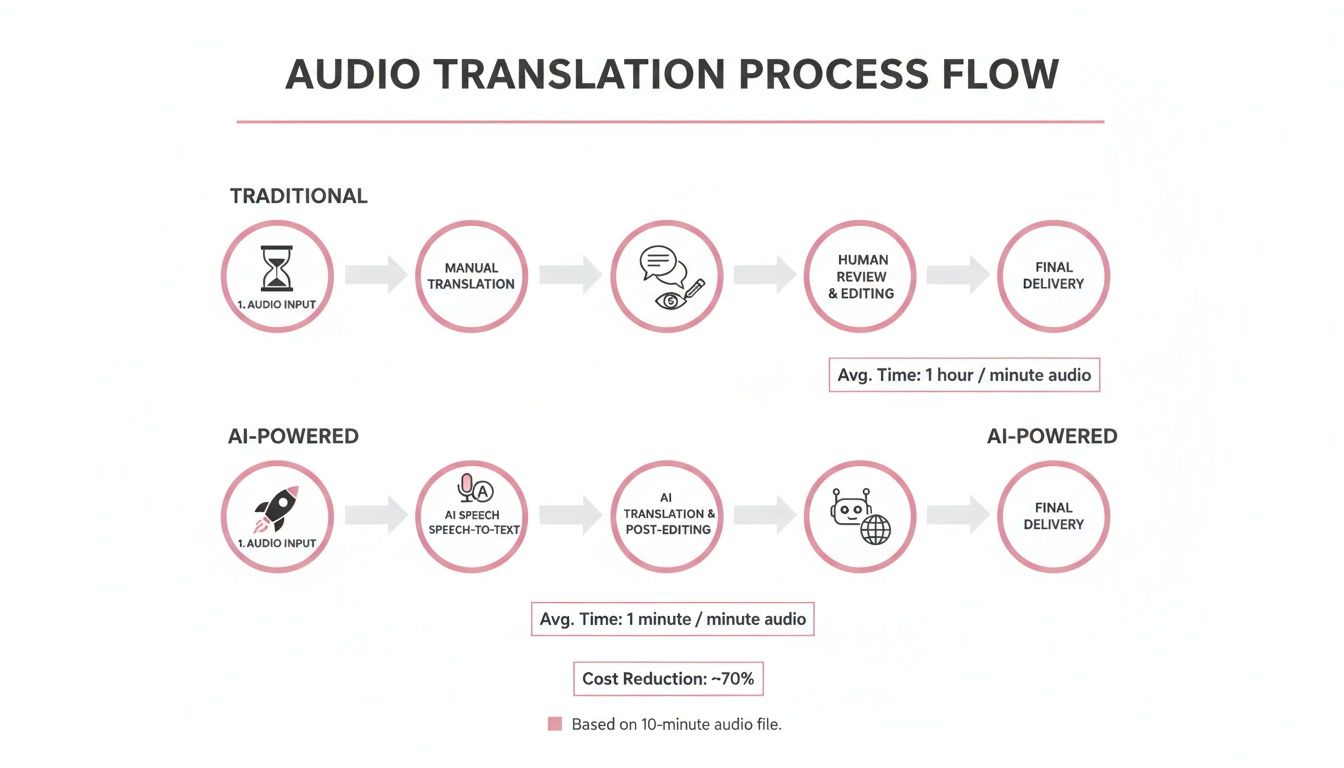
As you can see, the AI-powered workflow shrinks the timeline considerably, letting you get content out the door faster without cutting corners on quality.
From Sound Waves to Text
Every solid translation starts with a rock-solid transcript. This is your foundation. Automated transcription tools are your best friend here, using AI to turn your original English audio into an accurate text file. Forget manual transcription—this is way faster and much easier on the budget.
If you're a video creator, getting that transcript is also the first step to slicing and dicing your content for other platforms. For instance, if you're trying to pull short clips from a longer recording, you'll want to know how to convert a YouTube video to text efficiently.
With a clean English script in hand, it's time for the next stage: machine translation. Modern neural machine translation (NMT) engines are incredibly powerful and handle the initial pass from English to German. We're not talking about clunky, word-for-word translations anymore. These systems understand context and produce surprisingly fluent results right out of the gate.
The Essential Human Touch
Now for the most important part. While AI gives you speed and scale, the human post-editing stage is where the magic really happens. This is where a skilled, native German speaker takes the machine's output and refines it. Their goal is to transform a technically correct translation into one that is culturally resonant.
A human editor does so much more than fix grammar. They make sure your brand's tone is right, that the jokes land, and that the language feels completely authentic to a German-speaking audience.
Think about a common American business phrase like, "Let's hit a home run on this project." A literal German translation would make no sense. A human post-editor knows to swap it for a culturally relevant equivalent, like "Lass uns bei diesem Projekt einen Volltreffer landen" (Let's land a bullseye on this project).
This is what they're checking for:
- Cultural Nuances: Adapting idioms, metaphors, and local references that a machine would miss.
- Brand Voice: Making sure the language reflects your established brand personality.
- Linguistic Flow: Polishing sentence structures so they sound natural and are easy to read.
Finalizing with Timecode Alignment
The last technical piece of the puzzle is timecode alignment. Whether you've chosen subtitles or a full audio dub, the German content must sync perfectly with what's happening on screen. There's nothing more distracting or unprofessional than misaligned timing.
Proper alignment makes sure that when someone on screen speaks, the German subtitle appears at that exact moment or the dubbed audio plays in sync. Getting this right is crucial for creating a polished, professional product that feels completely native to your German viewers.
Choosing the Right German Voice for Your Content
With a polished German script in hand, it’s time to give your words a voice. This is a big decision point in the audio translation process: do you go with a synthetic AI voice from a Text-to-Speech (TTS) tool, or hire a professional human narrator? Each option has its own set of pros and cons, and the best choice really comes down to your project's goals, timeline, and budget.
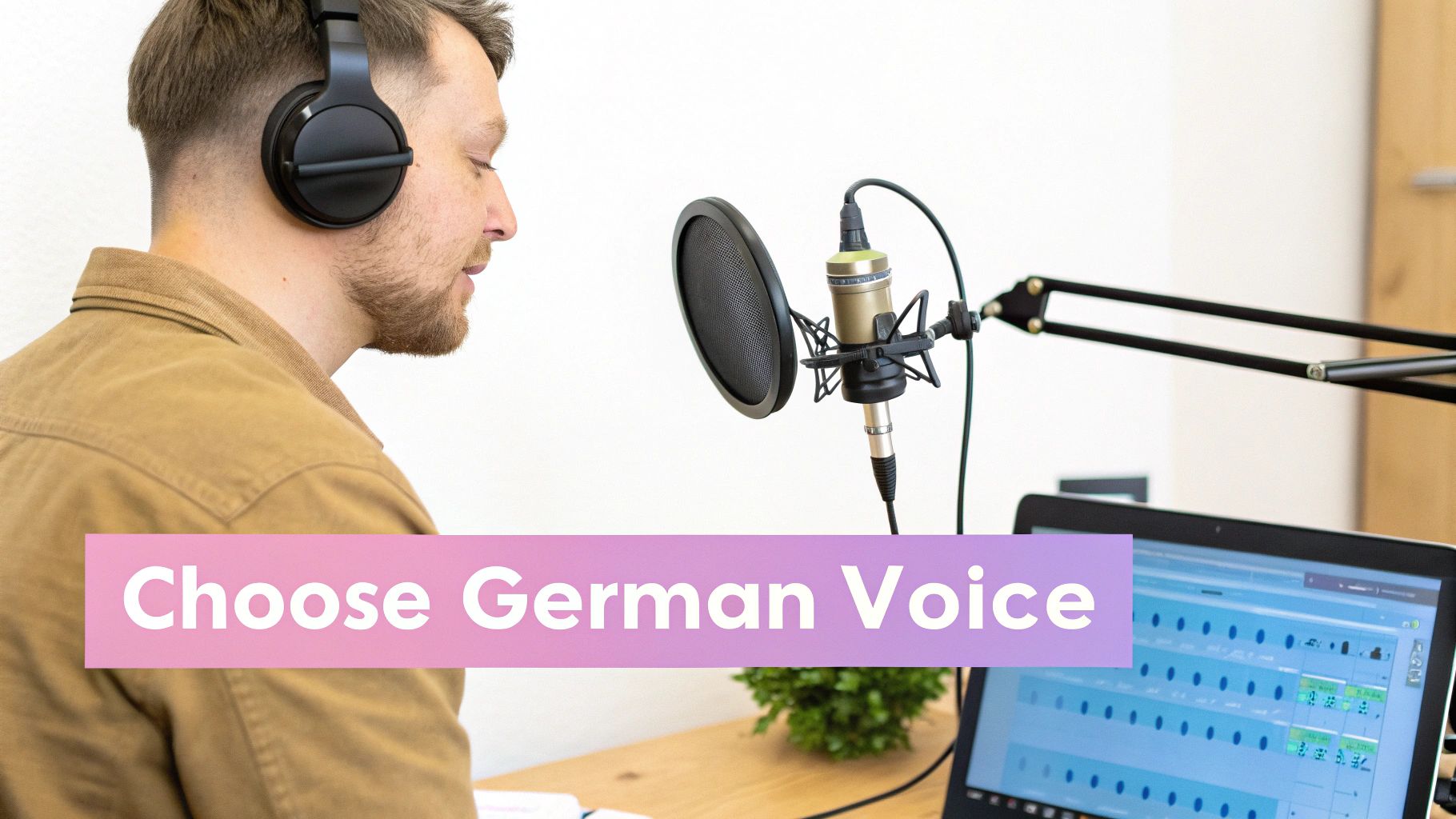
AI-powered TTS technology has come a long way. It offers incredible speed and is way more budget-friendly, making it a fantastic option for projects that need to be done quickly and at scale. The quality of these voices is surprisingly good now, with many capable of capturing tone and cadence in a remarkably natural-sounding way.
Think about a digital marketing agency that needs to crank out 50 unique social media video ads for a new German campaign. Using TTS means they can generate consistent, clear voice-overs for every single ad in a few hours, not weeks. That kind of speed is a serious competitive edge.
Selecting the Perfect TTS Voice
Don’t just pick the first AI voice you see. To make your content feel genuine and connect with your audience, you need to be intentional about the voice you choose.
- Gender and Tone: What fits your brand and message? A firm, authoritative male voice, or a warm, welcoming female one? The tone should match your brand’s personality, whether that's strictly professional, casual and friendly, or high-energy.
- Dialect and Accent: Germany has distinct regional accents. A standard "High German" (Hochdeutsch) is almost always a safe bet for a broad audience. But if you're targeting a specific region, like Bavaria or Berlin, using a local accent could make your content feel much more authentic.
- Pacing and Clarity: Before you commit, always listen to a preview. Is the pacing natural? Is it easy to understand? Nothing turns a listener off faster than a voice that sounds rushed, choppy, or robotic.
When a Human Narrator Is Essential
Even with all the advancements in AI, a professional human voice actor is still the undisputed champion for projects that need to forge a real emotional connection. The subtle inflections, nuanced delivery, and raw emotion a person can bring to a script simply can't be replicated by a machine. Research shows that human voices generate 24% more positive emotional response from listeners than synthetic ones, which is huge for building brand trust.
For projects like a feature-length documentary or a powerful brand story, the investment in a human narrator is absolutely worth it. Their ability to truly interpret the script and inject a layer of humanity can elevate the entire piece and leave a lasting impact on your audience.
If you go this route, you can find great talent on platforms dedicated to voice-over artists, where you can listen to demos and compare rates. Pay close attention to their past work to find a voice that truly captures the essence of your brand. Once you've found your narrator, there are several effective methods for adding professional voice-overs to ensure the final audio mix sounds seamless.
Ultimately, whether you choose an AI voice or a human one, the goal is the same: to find a voice that sounds completely authentic to your German-speaking audience.
How to Make Sure Your German Audio Sounds Genuinely German
You can have a translation that’s technically perfect, word-for-word, yet it still sounds… off. It’s a common pitfall. To a native German speaker, it might come across as robotic or just plain weird. This is precisely why the Quality Assurance (QA) phase isn't just a box to check—it's arguably the most critical step in the entire workflow. It’s what transforms a decent translation into something that truly connects with a German audience.
The real goal here isn't just about getting the words right; it's about achieving cultural fluency. A machine can nail the grammar, but it takes a human ear to catch the subtle nuances—the rhythm, the tone, and the context—that make communication feel real. This is especially true when dealing with idioms and colloquialisms that almost never translate directly.
The Ultimate Litmus Test: A Native Speaker's Ear
If there's one thing you absolutely shouldn't skip, it's the native listener test. Get a fluent, native German speaker to listen to the final audio from start to finish. Think of them as your final line of defense against awkward phrasing, cultural blunders, and those little mistakes that automated tools will always miss.
For instance, an English script might casually use the phrase "let's spill the beans." A direct, literal German translation—"lass uns die Bohnen verschütten"—is gibberish to a native speaker. They would be completely confused. A human reviewer, on the other hand, would instantly catch this and suggest a proper cultural equivalent, like "Jetzt pack mal aus" (literally "Now unpack it") or the classic "Raus mit der Sprache" ("Out with the language").
Key Insight: Your native listener isn't just a proofreader; they're your cultural guide. Their feedback is what ensures your message isn't just understood, but that it lands well and builds trust with your new audience.
A Practical QA Checklist for You and Your Reviewer
To keep things organized and make sure nothing slips through the cracks, it helps to use a structured checklist for both your internal review and your native listener. This ensures you’re covering all the bases.
Here are a few things that should be on your list:
- Linguistic Accuracy: Is the grammar flawless? Are specialized or technical terms translated correctly and used consistently throughout?
- Cultural Nuance: Have all idioms, slang, and cultural references been properly adapted for a German audience? Or removed if they don't fit?
- Tone and Style: Does the voice and language choice match your brand’s personality? Is the tone right for the material—formal for a business presentation, conversational for a vlog?
- Technical Audio Quality: Listen for any issues. Is the audio clear and free of background noise, clicks, or pops? Is the volume consistent? For dubbing, does the audio sync perfectly with the on-screen action?
The effort you put into quality pays off. The market for speech-to-speech translation, the technology that powers this whole process, is projected to hit USD 0.69 billion in 2025 and swell to USD 1.15 billion by 2030. And with top-tier machine translation from English to German already reaching 96% accuracy, that final human touch is what bridges the gap to near-perfection.
Of course, great output starts with great input. Making sure your source audio is clean and professional is just as important. For anyone editing their own content before translation, the right software makes all the difference. You can explore our guide on the best podcast editing software to get your source files in top shape.
Ultimately, a rigorous QA process ensures your final product feels like it was made for the German market, not just translated into it.
Taking Your Translation Workflow to the Next Level: Automation for Scale
If you're only translating a few files here and there, a manual workflow is fine. But when you need to pump out a steady stream of localized content, that hands-on approach quickly becomes a massive bottleneck. Juggling transcription, translation, voice-overs, and syncing for every single project just isn't sustainable.
This is where you need to start thinking like an engineer and build an automated pipeline.
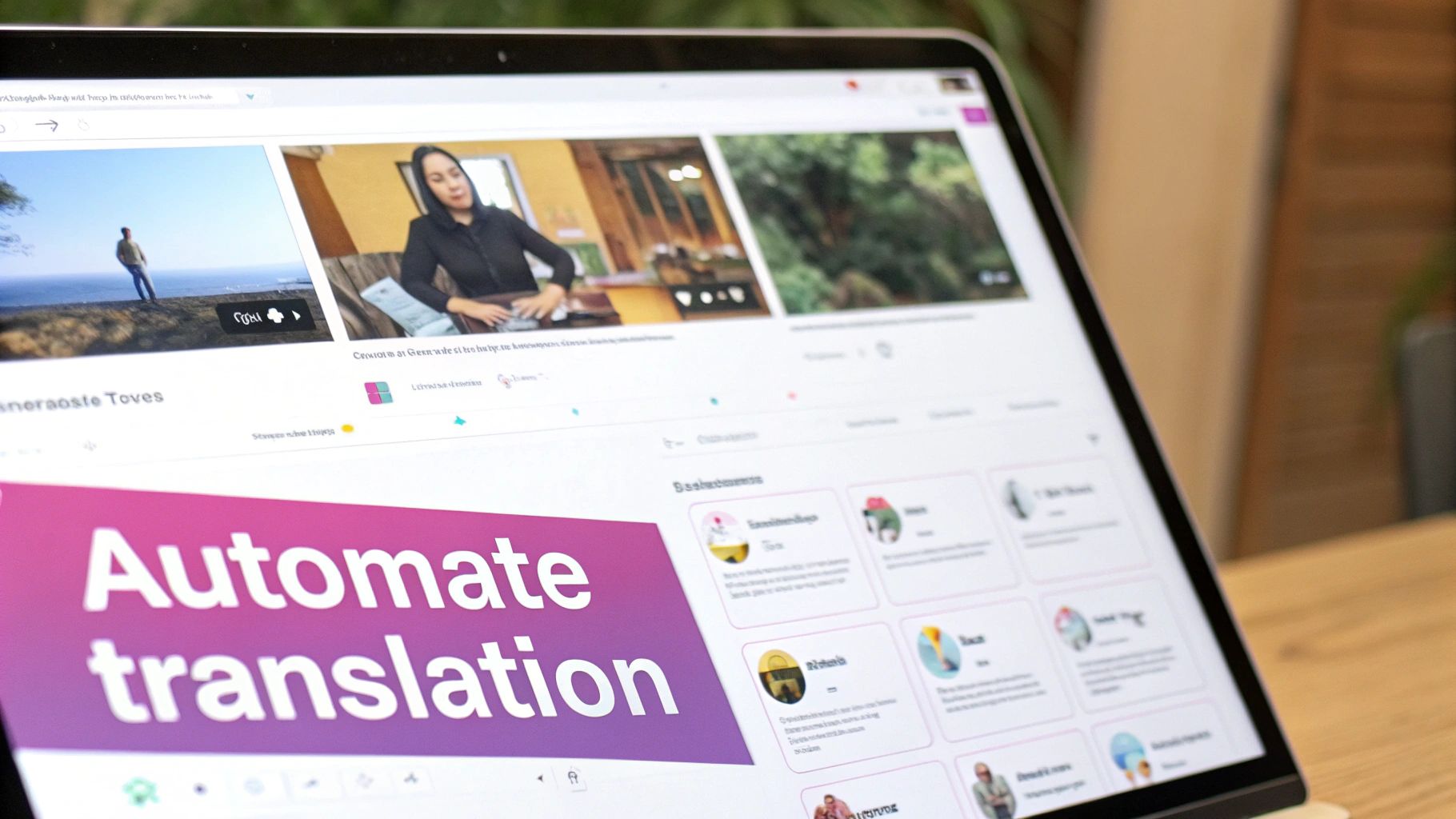
The idea is simple: connect the best modern tools so they talk to each other, creating an integrated system that does the heavy lifting for you. You move from a series of disconnected tasks to a fluid process that runs from audio upload to final German output with minimal human intervention.
It’s about producing more content with far less effort, freeing up your team to focus on creative strategy instead of repetitive production chores. This is how you genuinely scale your content operations.
Building a Content Repurposing Engine
Let's imagine a content agency that runs a successful English podcast. They see a huge opportunity in the German market and want to chop up their long-form episodes for social media. An automated pipeline can make this incredibly efficient.
Here's how that might look in the real world:
- Initial Upload: The team uploads their latest one-hour English podcast episode into their system.
- The Magic Happens: The pipeline kicks into gear, automatically transcribing the audio, running it through machine translation into German, and then generating a synthetic German voice-over.
- Smart Clipping: AI then scans the content, identifies the most shareable moments, and churns out dozens of short, German-dubbed video clips formatted for TikTok, Instagram Reels, and YouTube Shorts.
- Final Polish: Each clip is automatically stamped with the agency's logo and burned-in German captions, ready for immediate publishing.
What they've built isn't just a translation tool; it's a full-blown content repurposing engine. They take one asset and, almost instantly, turn it into a high volume of localized content, hitting a brand-new audience at a speed that would be impossible manually. Some of the more advanced speech-to-speech AI solutions can even make this process feel seamless by converting spoken English directly into natural-sounding German audio.
The Power of API Integration for True Scale
For businesses that need this functionality baked directly into their own products or platforms, an Application Programming Interface (API) is the key. An API is essentially a bridge that lets different software systems communicate and work together automatically.
By connecting your transcription, translation, and video editing tools through an API, you can construct a custom pipeline that operates entirely in the background. It just works, processing content at a massive scale without anyone needing to click a button for each step.
This is a game-changer for social media management platforms, large media companies, or any B2B service handling massive amounts of video. They can offer their own users the ability to translate and repurpose content on the fly, directly within their interface. To really understand what's possible, it's worth digging into the benefits of using an API for video repurposing and how it can become the foundation of a truly scalable global content strategy.
Automating your English-to-German audio pipeline is what allows your team to break into new markets effectively, ensuring your message connects with a global audience without the classic production headaches.
Got Questions About Audio Translation? We've Got Answers
Stepping into audio translation for the first time? It's completely normal to have questions. Getting a handle on the process, from timelines to potential trip-ups, is the best way to set your project up for success.
Let's dive into some of the most common questions we hear from people just starting to translate their content from English to German. We'll cover everything from how long it takes to the classic mistakes you'll want to avoid.
How Long Does It Really Take to Translate an Hour of Audio?
Thanks to modern AI tools, this is a lot faster than you’d probably guess. For a one-hour audio file, you can expect an automated transcription in about 10-15 minutes. The machine translation that follows? That takes just a few moments.
The real variable is the human touch. The post-editing and review phase, where a real person refines the machine's work, usually takes between 2 and 4 hours. This time frame can change based on how technical the audio is and the quality you're aiming for.
But what if you're making short video clips for social media? With a fully automated workflow, you can go from an English audio file to a polished, ready-to-share German video in just a couple of minutes. This is what makes it possible to really scale up your content for a new market.
What Are the Biggest Mistakes People Make?
The single biggest error is shipping raw machine translation without a human ever looking at it. That's a recipe for awkward, unnatural-sounding content.
The worst translation mistakes aren't just about grammar; they're about culture. A phrase that lands perfectly in English can come across as bizarre or just plain wrong when translated word-for-word into German. It’s a dead giveaway that the content wasn’t made with a German audience in mind.
Keep an eye out for these three common pitfalls:
- Translating Idioms Literally: English expressions like "it's raining cats and dogs" don't have a direct German equivalent. A literal translation will just leave your audience confused.
- Messing Up Gendered Nouns: German is built on gendered nouns (der, die, das). While AI is getting better, it can still mix these up, making the final text feel stilted and unprofessional.
- Bad Audio Syncing: If you're dubbing, a small mismatch between what's happening on screen and the German audio is incredibly jarring. It instantly makes the video feel low-budget.
Can AI Handle Technical or Creative Content?
Absolutely, but you need a different approach for each.
For something highly technical, like a medical lecture or an engineering guide, AI does a great job of keeping terminology consistent. You still need a human expert to give it a final look, just to be sure every nuance is correct.
When it comes to creative work—like a story-driven podcast or a marketing video—AI is an incredible assistant. It gives you a solid first draft in record time, but you absolutely need a human editor to inject the right emotion, nail the cultural references, and make sure the humor actually works for a German audience.
Ready to automate your audio translation and scale your content production? Swiftia transforms your long-form English content into dozens of short, shareable German clips in minutes. Start creating with Swiftia today.