If you're wondering how to get more views on YouTube Shorts, you're not alone. It's not about some secret hack or a single viral video. The creators who consistently pull in big numbers have a system—a smart mix of great content, sharp optimization, and a relentless posting rhythm.
It all starts with a killer hook. You have to grab someone's attention immediately, or they're gone. From there, it’s about structuring your video to keep them watching, using the right sounds, and showing up consistently. Nailing these fundamentals is your first real step toward blowing up on the platform.
A Practical Blueprint for High-Performing YouTube Shorts
Let's be real: trying to go viral on Shorts can feel like a lottery. But the channels that grow sustainably aren't just getting lucky. They've built their strategy on a repeatable foundation that the YouTube algorithm understands and rewards. It’s less about chasing every single trend and more about building a system that works for you.
The first thing you have to accept is that the Shorts feed is brutal. Viewers have zero patience. You have maybe a second, tops, to stop them from swiping. That's why your hook isn't just important; it's everything. If your first two seconds don't land, the rest of your amazing content might as well not exist.
Core Strategies for Shorts Success
The actual structure of your Short is just as critical. A lot of people think shorter is always better, but the data tells a different story. One of the biggest levers you can pull is optimizing your video length. After looking at thousands of Shorts, a clear pattern emerged: videos between 50 and 60 seconds long pulled in an average of 1.7 million views.
Why? Longer videos (within that 60-second limit) give the algorithm more watch time data. More watch time signals a quality video, which YouTube then pushes to more people. You can dig into more of the numbers in our full research on YouTube Shorts statistics.
Of course, what people are hearing matters, too. Jumping on a trending song or sound can be a massive shortcut to getting seen. It instantly places your content in front of an audience that's already engaging with that audio, giving you a huge reach-boost beyond your subscribers.
And finally, you have to be consistent. A regular posting schedule does two things: it trains your audience to expect new content from you, and it signals to the algorithm that your channel is active and serious. Both are crucial for building momentum.
To make this easier to remember, I've broken down these core ideas into a simple table.
The Four Pillars of YouTube Shorts Growth
Here's a quick-reference table that boils down the entire strategy into four key areas. Think of these as the foundation for every Short you create.
| Strategy Pillar | Why It Works | Practical Example |
|---|---|---|
| The Hook | Captures attention in the first 1-2 seconds, preventing viewers from swiping away. | A tech reviewer starts with "Do NOT buy the new iPhone until you see this." |
| Video Length | Videos between 50-60 seconds maximize watch time, a key signal for the algorithm. | A cooking Short shows a full 55-second recipe from prep to final plating. |
| Trending Audio | Taps into existing viral trends, boosting your Short's visibility and reach. | A fitness creator uses a trending pop song for a workout montage video. |
| Consistency | Builds audience habits and signals to YouTube that your channel is active. | Post one Short every single day at 5 PM EST without fail for a month. |
Mastering these four pillars is what separates the channels that get a few hundred views from those that consistently hit thousands, or even millions.
Key Takeaway: A winning Shorts strategy isn't complicated. It's built on four pillars: an irresistible hook, optimized video length (aim for 50-60 seconds), smart use of trending audio, and a rock-solid posting schedule. If one of these is weak, it can drag down your entire effort.
By focusing on these core ideas, you’re not just making videos; you're creating a powerful system for growth. Each piece works together to grab attention, hold it, and convince the algorithm to show your work to the world.
Making Content People Can't Swipe Past

Generic advice won't get you anywhere in the ruthless, fast-paced world of the Shorts feed. If you really want to know how to get more views on YouTube Shorts, you have to get good at creating content that physically stops a viewer's thumb from swiping up. This isn't just about having a cool idea; it's about engineering that idea to deliver a punch in under 60 seconds.
The whole battle is won or lost in the first two seconds. If you don't spark immediate intrigue, curiosity, or an emotional reaction, your viewer is already gone. The algorithm is watching, and the 'Viewed vs. swiped away' metric is a brutal but honest judge of your content's first impression.
Crafting an Unskippable Hook
The hook is everything. Seriously, it's the single most critical part of a successful Short. Think of it as a promise to the viewer that sticking around will be worth their time. Don't waste a single frame on a slow intro—jump straight into the action, the conflict, or the most interesting part of your story.
You don't have to reinvent the wheel every time. Using a proven framework is a solid way to consistently grab attention.
- The Problem-Agitate-Solve Framework: Kick things off by showing a relatable pain point. A cleaning hacks channel opens with a close-up of a horribly burnt stovetop stain (Problem). Then, show a quick montage of failed cleaning attempts with a frustrated sigh in the background (Agitate). Finally, reveal a dead-simple, one-wipe solution (Solve).
- The Curiosity Gap Opener: Present something weird or make a bold claim that just has to be explained. A tech creator could start with, "This one setting is secretly killing your phone's battery by 20%." That immediately creates an itch the viewer needs to scratch.
Your hook's only job is to get them to watch the next three seconds. The rest of your video's job is to deliver on that hook's promise and keep them watching to the very end. That's the secret loop to high retention.
Stuck for ideas? We've all been there. For a constant stream of inspiration, check out our guide on compelling YouTube Shorts ideas to keep your content calendar full.
Mastering the 60-Second Story Arc
Every great Short tells a complete story, even if it's tiny. You don't need a complex plot, but you do need a clear beginning (the hook), a middle (the value or transformation), and an end (the payoff).
Take a fitness creator, for example. They could start with a clip showing someone doing a squat with terrible form (the beginning). The middle section would then demonstrate the correct form, maybe with some on-screen text pointing out key fixes. The end is the payoff: a quick text overlay saying something like, "Avoid injury & build more muscle."
This simple narrative structure keeps people locked in because it feels satisfying and complete, which is a massive boost to your average view duration.
Using Audio to Your Advantage
A lot of people watch with the sound off, but don't underestimate the power of trending audio as a discovery tool. The algorithm loves to push content using popular sounds to new audiences. But just slapping a trending song on your video isn't a magic bullet. The real trick is to spot rising trends before they're completely saturated.
A good place to hunt for these is the 'Shorts' tab on popular music videos or an artist's official channel. You can see how others are using the sound, which can spark a unique idea for your own content.
Of course, you want to make sure you're doing this legally. For creators looking to grow without running into trouble, this ultimate guide to licensing music for YouTube is a must-read. Understanding the rules means your videos won't get flagged, demonetized, or taken down, protecting all your hard work. When you combine smart storytelling with the right audio, you’re not just making entertaining content—you’re giving it the best possible shot at going viral.
Getting Your Shorts Seen by the Right People
Making a fantastic Short is only half the job. The other half? Making sure the YouTube algorithm actually knows who to show it to. This is where a little behind-the-scenes optimization makes a massive difference. Think of it as giving your video a GPS so it can find its perfect audience.
So many creators just hit "upload" and cross their fingers, but that's like publishing a book without a title or a cover. By dialing in on three key things—your title, hashtags, and thumbnail—you're giving YouTube the exact clues it needs to put your Short in front of the right eyeballs at the right time.
Crafting Titles That Get Clicks
Your title is one of the first things the algorithm scans. A lazy, vague title can torpedo your video's potential before it even gets going. The trick is to write a title that's both descriptive for the algorithm and irresistible to a human scroller.
For example, instead of a bland title like "Cool Kitchen Hack," you'd get way more traction with something like "The 5-Second Trick to Peel a Garlic Clove." See the difference? It's specific, packed with keywords someone might actually search for ("peel a garlic clove"), and piques curiosity. It screams value.
Key Takeaway: A great title instantly answers the viewer's silent question: "What's in it for me?" Keep it clear, concise, and loaded with keywords that appeal to both search bots and human psychology.
How to Use Hashtags Strategically
Hashtags aren't just for show; they're powerful sorting tools. Using them the right way helps YouTube figure out what your video is about and match it with viewers who are already watching similar stuff. The secret is to use a smart mix of broad and specific tags.
First things first: always include #shorts. This is non-negotiable. It's the primary signal to YouTube that this is, in fact, a Short. After that, it's time to get more specific.
- Broad Tags: Think big-picture categories like
#lifehacksor#cooking. These get tons of searches but are also super competitive. - Niche Tags: These are much more focused, like
#kitchenhacksor#garlicpeeler. They have less search volume but connect you with a die-hard, engaged audience.
For that garlic-peeling video, a killer hashtag combo would be: #shorts #kitchenhacks #cookinghacks #garlichack. This blend gives your video multiple paths to be discovered. If you really want to go deep, our guide on the best hashtags for YouTube Shorts will help you dial in your strategy.
Why You Can't Ignore Custom Thumbnails
I know what you're thinking—thumbnails don't show up in the Shorts feed, so who cares? Well, you should. While they don't appear during the endless scroll, custom thumbnails are your secret weapon for getting views from everywhere else on YouTube.
A compelling custom thumbnail is the first thing people see when:
- They land on your channel page.
- Your Short pops up in YouTube search results.
- Your video gets recommended next to a regular, long-form video.
Don't just take my word for it. YouTube's own data shows that 90% of the best-performing videos on the entire platform use custom thumbnails. That statistic says it all. Picture someone searching for "easy cooking tips." A bright, clean thumbnail showing a perfectly peeled garlic clove will always beat out a blurry, auto-grabbed frame. Your thumbnail is your video's billboard—make it impossible to ignore.
Developing a Smart Posting and Promotion Strategy
Once you've poured your effort into creating and polishing a great Short, the job's not done. You have to get it in front of people. Honestly, success with YouTube Shorts is just as much about your rhythm and promotion as it is about the video itself. A scattergun approach just won't cut it; you need a deliberate plan for when you post and how you share your work. This is how you train both the algorithm and your audience.
I've seen so many creators burn out chasing an insane posting frequency. But here’s the secret: the key isn't to post constantly, it's to post consistently. A sustainable schedule is what builds the momentum that the algorithm picks up on and rewards. Think of it like a hit TV show—viewers learn when to tune in, and the network (in this case, YouTube) learns when to push it.
Finding Your Posting Rhythm
If you're trying to figure out how to get more views on YouTube Shorts, establishing a reliable posting cadence is non-negotiable. It’s a loud and clear signal to YouTube that your channel is active and serious about delivering value.
For instance, a creator who consistently posts three top-notch Shorts every Monday, Wednesday, and Friday at 5 PM EST is going to build way more momentum than someone who dumps ten random videos throughout the week. Consistency creates anticipation. It turns casual viewers into loyal subscribers who know exactly when to check back for your next video.
But what’s the best time to post? The answer isn't some universal secret; it's hiding in your own analytics.
- Dive into YouTube Studio: Head over to your channel's Analytics tab and find the "When your viewers are on YouTube" report. It’s a goldmine.
- Identify Peak Hours: This chart shows you the precise days and times your audience is most active. The darker the purple bars, the more people are online watching.
- Schedule Accordingly: Use this data to schedule your Shorts to go live about an hour before these peak times. This gives the algorithm a chance to index your video right as your audience starts scrolling.
This data-driven approach takes the guesswork out of the equation. It ensures your content drops when the maximum number of your followers are there to see it, giving it that critical initial boost.
The Power of Consistent Uploads
Posting Shorts on a regular schedule is a proven way to multiply your views. With over 12 million uploads hitting the platform daily, channels that stick to a daily or near-daily schedule often see a massive spike in algorithmic promotion. YouTube's own numbers are staggering, with daily Shorts views jumping from 70 billion to 90 billion, fueled by 2 billion logged-in users every month. The top creators treat their Shorts schedule like a broadcast, aiming for 3-7 posts per week to build momentum. The algorithm loves both recency and volume, and it rewards consistent channels by pushing their content into more feeds. You can find more insights into YouTube's explosive growth on adamconnell.me.
Key Insight: Never sacrifice quality for quantity. That said, a consistent volume of high-quality Shorts sends a powerful signal to the YouTube algorithm. Your goal should be a schedule you can actually maintain for the long haul without burning out.
Smart Cross-Platform Promotion
Your promotion strategy shouldn't live and die on YouTube. Tapping into your other social platforms can drive a ton of external traffic to your Shorts, but you have to do it the right way to avoid looking like a spammer. Just dropping a link with a generic "new video!" caption is a waste of a post.
The real goal is to create platform-native teasers—little bits of content that genuinely entice people to click through for the full story.
A Real-World Example: The Gaming Creator
Imagine a gaming creator. Instead of just linking to their new Short, they could post a 15-second clip on their Instagram Story showing the most intense moment—a clutch win, a hilarious fail, you name it. Then, instead of a boring "Link in bio," they use a poll sticker asking, "Did I clutch this win?" After someone votes, the creator can slide into their DMs with a personalized message and the link to the full Short on YouTube.
This approach works wonders because it feels personal and interactive. You're giving value directly on Instagram (an entertaining clip) while creating a powerful reason for them to click over to YouTube to see how it ends. It turns a simple promo into an engaging experience that spans multiple platforms.
How to Scale Your Shorts Production Without Burnout
Trying to post multiple new Shorts every single day is a recipe for burnout. I’ve been there. The secret that top creators know isn't about working harder—it's about building a smart, scalable content engine. The goal is a system that pumps out high-quality Shorts without you having to hit "record" from scratch every time.
The most effective way to do this? Repurpose your existing long-form content. Just think about it: a single 45-minute podcast episode or a 20-minute video essay is a goldmine. It's packed with dozens of potential Shorts just waiting to be clipped—a killer insight, a funny moment, or a powerful quote.
Transforming Long Videos into a Shorts Pipeline
This strategy is a game-changer for efficiency. Instead of the whole song-and-dance of brainstorming, scripting, and filming a new Short, you're just sifting through your existing library for treasure. It completely flips the script from, "What should I create today?" to, "What can I pull from what I’ve already made?"
This approach doesn't just save you a ton of time; it also works as a fantastic promotional tool. Every Short you create from a longer video is essentially a teaser trailer, driving curious viewers back to the original piece and breathing new life into your back catalog.
Here’s a practical workflow you can steal:
- Spot the Highlights: Go through your long-form video and timestamp every interesting story, surprising statistic, or actionable tip.
- Clip and Edit: Snip out those 30-60 second segments. The key is to find moments that can stand on their own without needing a ton of context.
- Format for Vertical: Reframe the clip for a 9:16 aspect ratio. Make sure the main subject is dead center and easy to see on a phone.
- Add Dynamic Captions: This is a must. So many people watch with the sound off, and animated captions are your best bet for grabbing and holding their attention.
To really speed this up, you can learn more about how to repurpose long videos into engaging short clips with AI, which automates a lot of the tedious clipping and captioning.
Key Takeaway: Stop treating your content like it's a one-and-done deal. Your long-form videos are a renewable resource. A single pillar video can easily fuel your Shorts calendar for weeks, guaranteeing a steady flow of content that keeps your channel growing.
Automating Your Workflow for Maximum Efficiency
Clipping videos by hand is a solid place to start, but let's be real—it can still be a major time-sink. Once you're ready to scale up, you’ll want to bring in tools that can do the heavy lifting for you.
To churn out more Shorts without the quality dropping, look into AI automation tools for scaling content creation. These platforms can automatically find the most shareable moments in your long videos, slap on captions, and format them perfectly for the Shorts feed. This frees you up to think about the bigger picture.
The numbers back this up, too. Marketing teams that use automation often see their productivity jump by 20%, giving them more time for high-impact tasks like strategy and community engagement.
This flow chart breaks down a simple but powerful strategy for scheduling, analyzing, and promoting your Shorts.
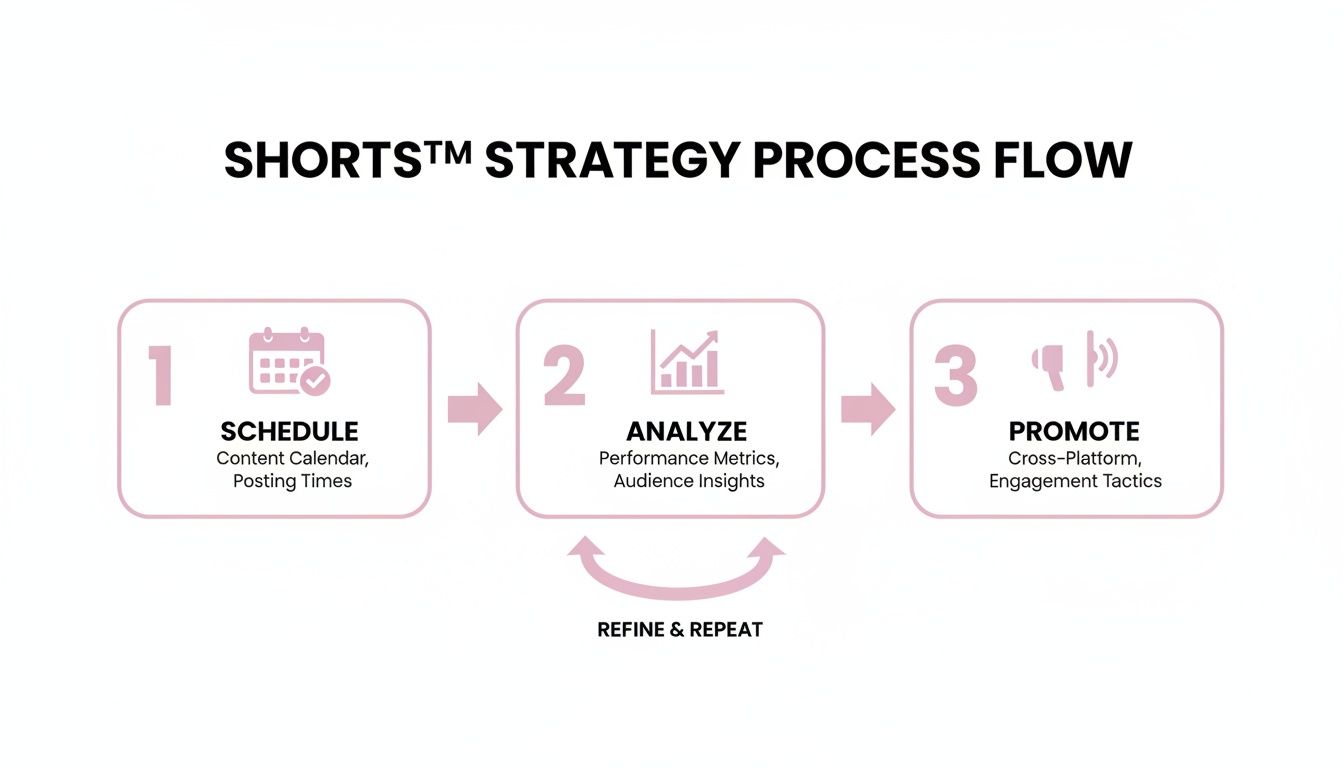
This cycle makes it clear that creating the content is just one piece of a much larger, ongoing puzzle of planning and refining.
By building a system around repurposing and automation, you create a sustainable workflow. This is how you maintain the high posting frequency the YouTube algorithm loves without burning yourself out. It's the ultimate strategy for playing the long game and winning on the platform.
Using Analytics to Drive Your Shorts Growth
It's time to stop guessing. If you want to grow, you have to let the data guide your content strategy. YouTube Analytics is your roadmap, but it's easy to get lost in all the numbers. The real secret is knowing which metrics actually matter for getting more views on your Shorts.
The most powerful, and honestly most overlooked, metric is ‘Viewed vs. swiped away.’ Think of this percentage as a brutally honest review of your hook. A high number (above 70%) means you're successfully stopping the scroll. A low number is a clear signal that the first one or two seconds of your Short just aren't cutting it.
Decoding Your Audience Retention
Getting someone to stop swiping is only half the battle; you still have to keep them watching. This is where your Audience Retention graph becomes your best friend. Don't just glance at the final percentage—look at the shape of the graph.
Are you seeing a steep, consistent drop-off around the 10-second mark on several of your Shorts? That's not a random coincidence. It's your audience telling you that the middle of your video isn't delivering on the promise you made in the hook. Maybe the pacing dies down, or the point of the video gets a little fuzzy.
Here's a practical example: A DIY creator I know kept seeing a massive viewer exodus right before the final project reveal. The retention graph made it obvious: her outro was way too long. She cut it down to a quick, punchy payoff, and her average view duration shot up by 15% on her next batch of Shorts.
A/B Testing Your Way to Success
Your analytics are the key to systematically improving your content. The trick is to A/B test by isolating one single variable at a time to see what moves the needle. This takes the guesswork out of the equation and helps you build a winning formula you can repeat.
Here are a few simple tests you can run:
- Hook Styles: For one week, try starting every Short with a question. The next week, kick them off with a bold, declarative statement. Compare your ‘Viewed vs. swiped away’ numbers to see which style hooks your audience better.
- Audio Choices: Take two similar Shorts. On one, use a trending pop song. On the other, use a viral soundbite or a piece of dialogue. See which one gets a bigger boost from the algorithm in the first 24 hours.
- Calls-to-Action (CTAs): Experiment with a verbal CTA ("Follow for more!") versus a simple text overlay at the very end. Then, check your analytics to see which one drove more new subscribers from that specific Short.
When you start treating your analytics less like a report card and more like a live feedback loop, you can make small, smart tweaks that add up to massive growth over time.
Your Top YouTube Shorts Questions, Answered
Even with the best game plan, you're bound to run into some specific questions as you get deeper into creating Shorts. Let's clear up a few of the most common ones I hear from creators.
How Many Hashtags Are Actually Necessary for Shorts?
You don't need to stuff your description with dozens of hashtags. In fact, that can be counterproductive. The sweet spot seems to be 3 to 5 really specific hashtags.
Always, and I mean always, include #shorts. That’s the non-negotiable one that tells YouTube exactly what kind of content this is. After that, add another 2 to 4 hashtags that genuinely describe your video. For example, if your video is about organizing a desk, use tags like #desksetup, #organization, and #homeofficehacks. This precision helps the algorithm find your ideal audience faster.
Should I Bother Deleting and Reuploading a Short That Flopped?
I know it’s tempting when a Short gets stuck at zero views, but my advice is: don't do it. This isn't a strategy that pays off in the long run.
Sometimes, the YouTube algorithm takes its sweet time—we're talking days, sometimes even weeks—to find the right audience for a video. Constantly deleting and re-uploading the same content looks spammy and, more importantly, you miss a huge learning opportunity.
A "failed" Short is just data in disguise. Instead of hitting delete, open up its analytics. Was the audience retention terrible? Maybe the first three seconds didn't hook them. Was the swipe-away rate high? Perhaps the topic wasn't as interesting as you thought. Use these insights to make your next video undeniably better.
Do Shorts Actually Help My Main, Long-Form Videos?
Yes, one hundred percent. This is one of the biggest (and most overlooked) benefits of creating Shorts. Think of them as the ultimate trailer for your entire channel.
Shorts are incredible for discoverability. Someone might stumble upon your 30-second clip, love your energy or expertise, and immediately click over to your channel to see what else you've made. It's a low-commitment entry point for new subscribers.
Here’s a practical example of how to make them work together:
- Create teasers. Post a killer moment from an upcoming long-form video to build hype.
- Repurpose your greatest hits. Clip out the most valuable or entertaining parts of your existing videos.
- Make complementary content. Create a Short that answers a common question related to one of your longer videos.
Don't forget to guide them! A simple "Check out the full video, linked in the comments!" can work wonders.
Ready to stop spending hours hunting for clips and start scaling your channel? Give it a try for free and see how much time you save: https://swiftia.io.