Ready to turn those viral clips into actual cash? Monetizing YouTube Shorts isn't just a fantasy anymore. It’s a real, viable path for creators, and it starts with getting into the YouTube Partner Program (YPP). But that's just the beginning—the real money often comes from a smart mix of ad revenue, brand deals, and affiliate marketing.
And the opportunity is massive. With Shorts now pulling in over 70 billion daily views, there's a huge audience just waiting for your content.
Your Path to YouTube Shorts Monetization
The main way to get paid directly by YouTube is through their Partner Program (YPP). For a long time, the YPP was built for traditional, long-form videos, making it tough for Shorts creators to break in. But things have changed.
YouTube finally recognized that Shorts are a completely different beast. They introduced a specific YPP entry path just for Shorts creators, which was a huge deal. It acknowledges that building an audience with quick, looping videos is different from racking up thousands of watch hours.
This means you can now build a monetized channel entirely with Shorts, without ever having to create a 20-minute vlog if that’s not your style.
The Two Roads to YPP Eligibility
So, how do you get in? YouTube gives you two options to qualify for the YPP. Knowing the difference will help you figure out the best content strategy for your channel. Are you a Shorts-only creator, or do you mix in longer videos?
No matter which path you take, you still need to hit 1,000 subscribers. That’s the one requirement both paths share.
For a clearer picture, let's break down the two routes side-by-side.
YouTube Partner Program Eligibility at a Glance
This table lays out the two main ways you can join the YouTube Partner Program. Whether you focus on long-form content or go all-in on Shorts, there's a clear path to getting monetized.
| Requirement | Traditional Path (Long-Form Video) | Shorts Path (Alternative) |
|---|---|---|
| Subscribers | 1,000 | 1,000 |
| Primary Metric | Valid Public Watch Hours | Valid Public Shorts Views |
| Threshold | 4,000 hours in the last 12 months | 10 million views in the last 90 days |
Think about it: a gaming creator might post a few hilarious clips that go viral and hit 10 million views in a month. That could get them into the YPP much faster than trying to accumulate 4,000 watch hours on long-form gameplay videos. This flexibility is a huge advantage.
You can learn more about crafting effective short-form content in our comprehensive guide.
The introduction of the 10 million views in 90 days threshold was a game-changer. It officially validated Shorts as a primary monetization vehicle, not just a promotional tool for longer content.
This shift empowers creators who are great at telling a quick, punchy story to build a real income on the platform. If you're looking for tools to help you master this format, platforms like ShortGenius are a good place to start exploring.
Getting into the YouTube Partner Program with Shorts
Your first major milestone on the path to making money with Shorts is getting into the YouTube Partner Program (YPP). This is the key that unlocks direct ad revenue. For years, the YPP was all about long-form video metrics, but YouTube finally rolled out a dedicated path for Shorts creators, and it's been a game-changer.
To get in, you have two main targets to hit: 1,000 subscribers and 10 million valid public Shorts views within a 90-day period. This new route is a huge relief for creators who are great at making quick, engaging content but struggle with longer videos.
What "Valid Public Shorts Views" Actually Means
But here's the catch: not every single view counts toward that 10 million goal. YouTube is pretty specific about what they consider a "valid public Short view" because they want to see real, organic engagement.
Here’s what you need to keep in your back pocket:
- It has to be public. Any views on Shorts you’ve set to private, unlisted, or have since deleted won't count.
- The Shorts Feed is king. The vast majority of your qualifying views need to come from people scrolling through the Shorts feed.
- Originality is non-negotiable. If you’re just re-uploading unedited clips from movies, TV shows, or other people’s channels, those views likely won't count.
This is a critical distinction. Let's say a Short goes viral on an external blog, but it gets almost no traction inside the Shorts feed itself. Those external views probably won't help you cross the finish line.
The real goal isn't just getting views from anywhere; it's about making content that the Shorts ecosystem loves. You need to create stuff that the algorithm wants to push and that people scrolling the feed will stop and watch.
Hitting that 10 million Shorts views in 90 days (along with the 1,000 subscribers) unlocks your 45% cut of the ad revenue from the Shorts pool. Even at a low RPM of $0.03, that’s about $300. More typical RPMs bring that to $600, and creators in high-value niches like finance can see as much as $1,200 for the same view count.
A Real-World Example: The Tech Creator
Picture this: you run a tech review channel. Ten million views in three months sounds like a massive mountain to climb, but it’s more achievable than you think if you're smart about it.
Instead of one long, 20-minute review of the latest smartphone, you could create a series of 15-20 Shorts. Each one could spotlight a single, cool feature—the camera's crazy zoom, a hidden software trick, or a quick battery drain test. This approach lets you pump out content quickly and multiplies your chances of a single clip taking off.
A Short titled "This iPhone trick is a game-changer" is far more likely to get picked up and shared in the feed than a random clip pulled from a long video. By concentrating on these high-impact, single-idea Shorts, you're constantly feeding the algorithm and your audience, steadily building your way to that 10 million view target.
Walking Through the YPP Application
Once you've officially hit the numbers, it's time to apply. You can keep an eye on your progress right inside YouTube Studio under the "Earn" tab.
The application itself is pretty straightforward:
- Review and Accept the Terms: First, you’ll have to agree to the Base Terms. Then you'll choose which "Monetization Modules" you want to turn on, making sure to include the Shorts Monetization Module.
- Set Up Your Google AdSense Account: This is how you get paid. You’ll either link an existing AdSense account or create a new one. Don't skip this or rush through it; it's a vital link in the chain.
- Wait for the Review: After you've done your part, your channel goes into a review queue. A real person at YouTube will look over your channel to make sure you're following all the rules, like the Community Guidelines and AdSense policies.
Getting a handle on all the YPP details is key, and you can get a more complete picture of how to monetize YouTube Shorts if you want to dig deeper.
And if your application gets rejected? Don't sweat it. YouTube will give you a general idea of why, which is usually tied to reused or repetitive content. You can fix the issues on your channel and reapply in 30 days.
Getting More Eyes on Your Shorts (and More Subscribers)
Before you can even think about monetization, you need an audience. That means getting your Shorts in front of people and convincing them to subscribe. It all starts with understanding the game: you have to grab their attention immediately and deliver something that makes them want more.
The first three seconds of a Short are do-or-die. You're fighting for a split-second of attention in an endless scroll. A shocking visual, a bold claim, or a question that makes someone pause is your best weapon against the swipe-away. That initial hook is everything.
Nailing the All-Important Hook
Your hook is your video's headline. It has to be sharp and promise something valuable right away. No time for a slow-burn intro; get right into the action.
Think about a food creator making a 30-second recipe. They shouldn't start with chopping onions. Instead, they should flash the final, mouth-watering dish on screen for a second before diving into the steps. That immediately tells the viewer, "This is what you're going to get," and gives them a reason to stay.
A great hook is a "pattern interrupt." Viewers are just mindlessly scrolling. You need something that jolts them out of that trance and makes them focus on your content.
Riding the Wave of Trends and Sounds
Using trending audio and participating in challenges is like pouring gasoline on a fire. The YouTube algorithm is designed to push content that uses popular sounds, giving your Shorts a shot at reaching a massive audience far beyond your current subscribers.
But don't just copy a trend mindlessly. You have to make it your own. If you're a fitness creator, use that trending song to showcase a quick workout. A channel focused on DIY projects could use a popular sound for a satisfying project reveal. The key is to adapt it to your niche.
- Scout the Shorts Feed: Spend time scrolling through Shorts to see what sounds, effects, and formats are blowing up.
- Adapt, Don't Just Copy: Put your own unique spin on it. That's how you ride the trend's wave without getting lost in the crowd.
- Move Fast: Trends come and go in a flash. When you spot one that fits your channel, don't wait around.
Turning Shorts Views into Channel Growth
Shorts aren't just about fleeting views; they are powerful engines for subscriber growth and for pushing traffic to your other videos. The numbers don't lie: Shorts bring in an average of 16.9 new subscribers for every 10,000 views. And with the format pulling in over 70 billion daily views worldwide, the opportunity is absolutely massive.
The algorithm favors Shorts that keep people watching, turning viral clips into subscriber magnets that can then point people toward your monetized long-form content. For a deeper dive into the data, check out these insightful YouTube Shorts statistics.
A classic, effective strategy is to use a Short as a trailer for a longer video. Show the most dramatic moment of a project or share one killer tip from a tutorial, then tell viewers to watch the full video linked in the comments or on your channel.
This creates a fantastic cycle: people find you through a short, snappy video, subscribe because they like your style, and then stick around to watch your longer content where you can earn more from ads. For more tips on this, read our complete guide on how to get more views on YouTube Shorts.
Exploring Revenue Streams Beyond Ad Revenue
Relying just on Shorts feed ad revenue is like putting all your eggs in one basket. It’s a great starting point, but the real money comes from building a diverse income strategy. Think of your ad share as the foundation, not the whole house.
This is especially true for Shorts creators. The numbers don't lie: only 8% of creators rely primarily on ad revenue. The savviest channels layer sponsorships, affiliate income, and their own products on top of whatever the Shorts feed pays out.
With the average Shorts RPM hovering between $0.03 and $0.10, even 10 million views might only net you $300 to $1,200. Smart creators learn how to multiply that figure. If you want to dive deeper, there are some great monetization insights that show how top creators are maximizing their earnings.
Landing Your First Brand Deal
Brand deals are often the single most lucrative income stream for Shorts creators. And you don't need a million subscribers to get started. Companies are hungry to partner with creators who have an engaged, niche audience, no matter the size.
First things first: you need a professional media kit. This is essentially your channel's resume, a quick one-pager that sells you and your audience to potential partners.
It should include:
- Your Niche: Get specific. Not just "food," but "Quick vegan recipes for busy professionals."
- Audience Demographics: Pull key stats from your YouTube Analytics—age, gender, and top countries. Brands need to know who they're reaching.
- Performance Metrics: Showcase your average monthly Shorts views, subscriber growth, and engagement rate.
- Contact Info: A simple, professional email address is all you need.
Once you have your media kit, start reaching out to brands that are a natural fit for your content. Forget mass-emailing. A personalized pitch that shows you've done your homework will get you a hundred times further.
A Real-World Pitch Scenario
Let's say you're a fitness creator getting 5 million Shorts views a month. Your audience is mostly men and women aged 25-40 who love your at-home workout routines. You want to work with a supplement brand that uses clean ingredients.
Don't just send a "Hey, sponsor me?" email. Instead, pitch them an actual idea:
"Hi [Brand Name] Team,
My channel, [Channel Name], serves up daily fitness Shorts to an engaged community of over 5 million monthly viewers, mostly health-conscious millennials. I’m proposing a three-part Shorts series showing how your protein powder fits into a hectic schedule: a morning smoothie, a post-workout recovery shake, and a creative recipe for protein pancakes.
The series would highlight the product's convenience and taste, solving a real problem for my audience. I’m confident we could drive some serious brand awareness and sales together."
See the difference? You’re not asking for a handout; you’re offering a strategic partnership with clear value.
Tapping into Affiliate Marketing
Affiliate marketing is a fantastic way to earn commission on products you already use and genuinely recommend. It’s an authentic win-win: your audience gets a solid recommendation, and you earn a cut when they make a purchase.
Getting set up is pretty straightforward. You can join big networks like Amazon Associates or look for programs directly on the websites of brands you love. Once you're approved, you'll get unique tracking links to use in your content.
The trick to making affiliate marketing work on Shorts is to make it seamless. Nobody wants to feel like they're being sold to.
- The Pinned Comment: This is the go-to method. Post a Short reviewing a new camera, then pin a comment: "You can find the camera I used here: [your affiliate link]."
- Link in Bio: Use a free tool like Linktree to create a simple landing page for all your affiliate products. Then, a quick "All my gear is linked in my bio!" at the end of a Short is all you need.
- Channel Description: Your main channel "About" page is another prime spot to list links to your go-to software, equipment, or other resources.
A single great Short can become a passive income engine, earning you commissions for months or even years after you post it.
Selling Your Own Products
This is the end game for many creators: moving from promoting other people's stuff to selling your own. This is where you transition from being a creator to a true business owner. Your products can be physical or digital—whatever makes sense for your niche.
Merchandise: The classics still work. T-shirts, hats, and mugs with your branding are easy to set up. Platforms like Teespring (now Spring) or Printify integrate with YouTube, creating a "merch shelf" right below your videos.
Digital Products: This is where your profit margins can really soar.
- A personal finance creator could sell a budgeting spreadsheet.
- A photography channel could sell a pack of custom Lightroom presets.
- A musician could offer digital sheet music or backing tracks.
By building out these different revenue streams, you insulate yourself from the whims of the algorithm and unpredictable ad revenue. You’re not just a YouTuber anymore; you’re building a sustainable business.
Scaling Your Content Production with AI Tools
Consistency is the lifeblood of any successful Shorts channel. It's also the single biggest hurdle for most creators. Manually chopping up long videos into dozens of short clips is a soul-crushing grind that leads straight to burnout. This is where AI-powered tools have completely changed the game, turning a tedious editing marathon into an efficient content engine.
These platforms were built to solve one problem: how to get more high-quality content out the door in less time. They’re designed to help creators, agencies, and media companies take their existing long-form content—think podcasts, webinars, or interviews—and slice it into a steady stream of engaging Shorts, often up to 10x faster than doing it the old-fashioned way.
From Hours of Editing to Minutes of Curation
Imagine this: you upload a single one-hour podcast episode and, a few minutes later, an AI presents you with 15 viral-ready clips, complete with compelling headlines and captions. This isn't science fiction; it's the actual workflow that top creators are using to dominate the feed. Your job shifts from being a video editor, hunched over a timeline, to a content curator. You're just reviewing and approving the best clips.
This freed-up time means you can focus on the big picture—strategy, creative ideas, and community engagement—instead of getting lost in the weeds of repetitive editing. It's a fundamental change that directly fuels your ability to monetize by ensuring you never run out of fresh content.
If you want to go deeper on this specific workflow, we break it all down in our guide on how to scale content creation.
The real win here isn't just about speed. It's about unlocking the mountain of value already sitting in your content library. Every long-form video you've ever recorded is a goldmine of potential Shorts, and AI is the machinery you need to start digging.
This infographic lays out the primary monetization paths that a high volume of Shorts can open up for you.
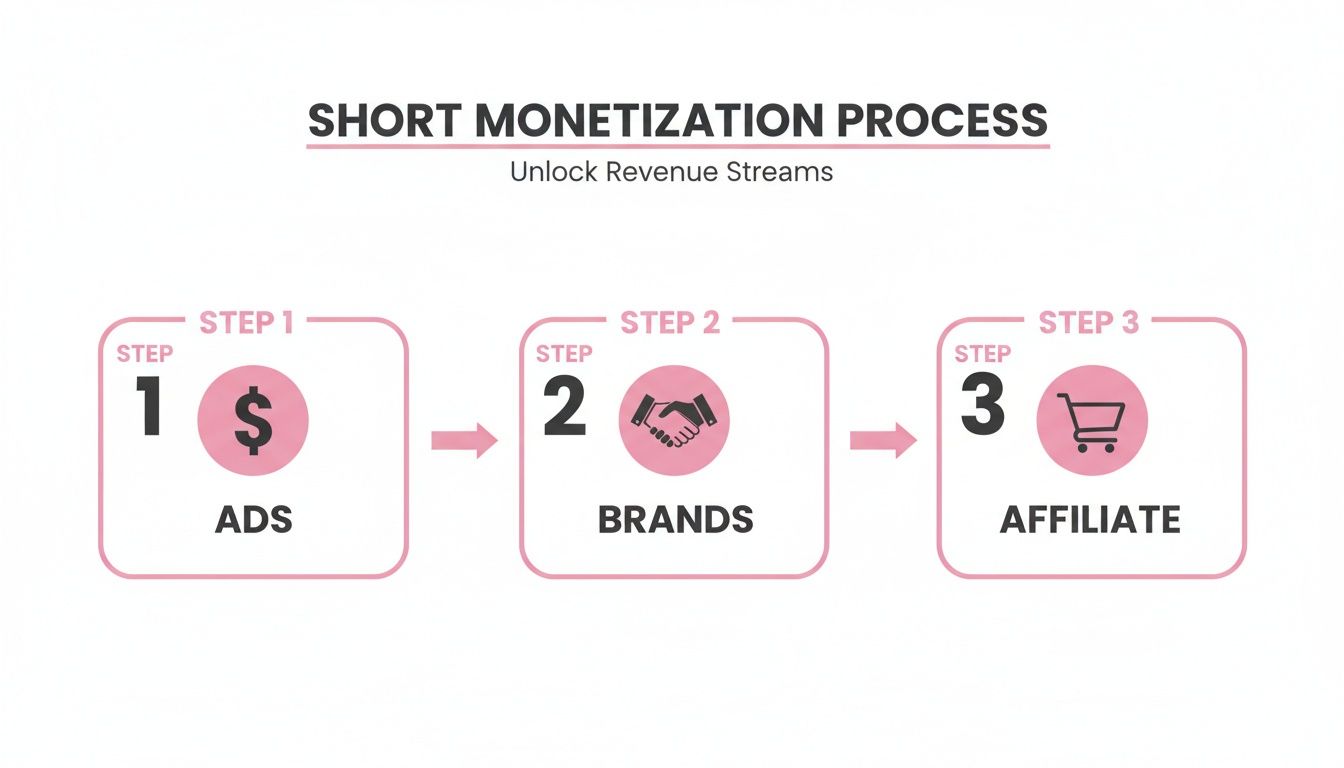
As you can see, a consistent flow of content is what drives ad revenue. That revenue builds the audience and authority you need to land brand deals and make affiliate sales work.
Key Features that Actually Boost Your Bottom Line
When you're looking at different AI tools, some features are nice-to-haves, while others are critical for creating clips that actually perform and make you money.
Tools like Swiftia are built with this in mind, offering a suite of smart features that go way beyond simple trimming.
- Dynamic Captioning Engine: Nobody has time to manually type out captions. This feature automates this with slick, customizable styles that match your brand. It’s not just about accessibility; 85% of social media videos are watched on mute. Good captions are non-negotiable for viewer retention.
- Automatic Filler Word Removal: All those "ums," "ahs," and long pauses can kill the energy of a clip. The AI automatically snips them out, making the speaker sound sharp and confident. It’s a small detail that makes your content feel way more professional.
- Multi-Language Support: Why limit yourself to an English-speaking audience? To really grow, you have to think globally. The ability to translate and generate your Shorts in over 90 languages lets you tap into huge international markets you couldn't reach before.
Why an All-in-One System is a No-Brainer
I see so many creators trying to duct-tape a workflow together with a bunch of different apps—one for clipping, another for captions, and a third for scheduling. It's clunky, inefficient, and a huge time-waster.
The smart move is an all-in-one platform like Swiftia that handles the entire process from start to finish. By having clip creation, captioning, and scheduling under one roof, you eliminate all the friction. For anyone serious about monetizing their YouTube Shorts, a streamlined system like this isn't a luxury; it's a major competitive advantage.
Your Blueprint for a Profitable Shorts Channel
Building a Shorts channel that actually pays the bills isn't about luck; it's about following a smart playbook with real, consistent effort. We've covered the essential pillars, starting with the absolute first step: getting into the YouTube Partner Program to turn on that first tap of ad revenue.
Once you're in, the game shifts to maximizing your reach. Creating Shorts that stop the scroll is the engine for everything else. It's what drives your ad earnings and, more importantly, opens the door to bigger and better income opportunities.
Stacking Your Revenue Streams
This is where the real growth happens. You move beyond basic ad-share and start stacking different revenue streams on top of each other. Think of it like building a business, not just a channel.
This means you're actively pitching brands, weaving affiliate links into your descriptions, and maybe even launching your own merch or digital products. The audience is massive—Shorts are pulling in over 70 billion daily views. Your job is to capture a slice of that attention and monetize it effectively.
The core idea is to work smarter, not just harder. Profitability isn't about grinding out endless videos; it's about building an efficient business around those videos.
By creating a streamlined workflow and deliberately pursuing multiple income paths, you can turn a creative hobby into a legitimate career. Use the strategies in this guide as your blueprint. Don't just aim for the minimum monetization threshold—build a thriving media business that generates reliable income, month after month. That's how you win the long game with YouTube Shorts.
Questions on Every Creator's Mind
Let's be honest, figuring out Shorts monetization can feel like a maze. You've got questions, and I've heard them all. Here are the straight answers to the most common things creators ask when they're ready to start earning.
How Much Can I Realistically Make from 1 Million Shorts Views?
Everyone wants to know the magic number, but the truth is, it's a range. For 1 million Shorts views, you can generally expect to see anywhere from $30 to $100.
Why the big difference? It all comes down to your audience and your niche. If you're running a finance channel, your RPMs will be higher because advertisers are willing to pay a premium to reach that audience. You'll likely be closer to that $100 figure. A general entertainment or meme channel, on the other hand, will probably land on the lower end of that scale for the same view count.
Do I Absolutely Have to Be in the YPP to Make Money from Shorts?
To get a cut of the official Shorts ad revenue, yes, you must be in the YouTube Partner Program (YPP). The fast-track for Shorts creators is hitting 1,000 subscribers and 10 million valid public Shorts views in the last 90 days.
But don't let that stop you from earning right now. Smart creators don't wait for YPP. They're making money from day one with affiliate links in pinned comments, securing brand deals, and selling their own merch. Your Shorts views are valuable traffic, even before YouTube pays you directly for them.
What's the Deal with Using Copyrighted Music in Monetized Shorts?
This is a tricky one, but the rule of thumb is pretty simple.
Using a track from YouTube's official Shorts audio library? You're generally in the clear to monetize. The catch is that the ad revenue gets split between you and the music rights holders, so your take-home pay will be smaller.
If you use copyrighted music that you just grabbed from somewhere else, expect a copyright claim. That video will be completely demonetized, earning you $0.
My advice? If you want to maximize what you earn, stick to your own original audio or use royalty-free music. It's the safest and most profitable way to go.
Is There a Faster Way to Create Shorts Without Burning Out?
Absolutely. The key to scaling your Shorts production is to stop creating every single clip from scratch. The most efficient creators I know have adopted a repurposing workflow.
They'll record one long-form video—like a podcast, a tutorial, or a Q&A—and then use an AI-powered tool to chop it up into dozens of short, punchy clips. This turns what used to be hours of tedious manual editing into a quick session of just reviewing and approving the best moments. It's a game-changer for consistency.
Ready to put this into practice and scale your content? Swiftia can take your long-form videos and turn them into a month's worth of viral-ready clips 10x faster. Start creating with a free trial today at swiftia.io and see how quickly you can fill your content calendar.