In a world seemingly built for short attention spans, it’s easy to think longer, more detailed content is a thing of the past. But that couldn't be further from the truth. So, what exactly is long form content? It's any substantial piece of content designed to dig deep and provide real, comprehensive value.
Think of articles that run over 1,500-2,000 words or videos that last longer than 10-15 minutes. This isn't about hitting a specific number; it's about moving beyond quick hits and surface-level updates to build real authority and forge a lasting connection with your audience.
Unpacking Long Form Content in a Fast-Paced World
A common mistake is thinking long-form is just about length. It's not. The real magic is in its depth.
Here’s a simple analogy: short-form content is the movie trailer. It’s exciting, fast, and designed to hook you in. Long-form content is the feature film itself—it tells the full story, develops the characters, and leaves you with something memorable.
This kind of in-depth content aims to be the definitive resource on a topic. It tackles complex subjects head-on, provides thoughtful answers to tough questions, and walks your audience through a complete journey. A short post gives a quick tip; a long-form guide delivers the entire solution.
The Strategic Role of In-Depth Content
Creating high-quality long-form content is one of the smartest investments you can make. When you cover a topic inside and out, you send a powerful signal to both your audience and search engines like Google: you're a credible expert who knows their stuff.
According to research from Semrush, articles over 3,000 words get 3x more traffic, 4x more shares, and 3.5x more backlinks than articles of average length (901-1200 words). They provide the substantial, trustworthy information that people are actively searching for.
This depth is crucial for a few key reasons:
- It builds trust. Investing the time to create a truly helpful resource shows you’re genuinely committed to your audience's success.
- It establishes authority. It positions your brand as the go-to expert in your niche, making you the first place people turn for information.
- It drives meaningful engagement. It attracts a dedicated audience that is truly interested in the topic and willing to spend time learning from you.
Practical Example: A fitness coach could share a 150-word Instagram post on the benefits of squats (short form). But they could also create a 3,000-word ultimate guide titled "Mastering the Squat: A Complete Guide to Form, Variations, and Common Mistakes," packed with diagrams and video clips. The first piece grabs attention; the second creates a loyal follower who sees the coach as a genuine expert.
Long Form vs Short Form Content at a Glance
Knowing when and where to use each content type is key to a well-rounded strategy. They aren't in competition; they work together to guide people from initial curiosity to deep-seated loyalty.
Here's a quick table to break down their distinct roles.
| Attribute | Long Form Content | Short Form Content |
|---|---|---|
| Primary Goal | Build authority, educate deeply, generate leads, and improve search rankings. | Grab attention, drive awareness, and encourage quick engagement (likes, shares). |
| Common Formats | In-depth blog posts, ultimate guides, case studies, webinars, podcasts. | TikTok videos, Instagram Reels, tweets, short social media posts, stories. |
| Ideal Use Case | Explaining complex topics, solving significant customer problems, proving value. | Announcing updates, sharing quick tips, showcasing brand personality, promoting events. |
As you can see, both play a vital part. Short-form content casts a wide net, while long-form content pulls the most interested people in deeper.
Why Investing in Long-Form Content Delivers Real ROI
Let's move past the theory. When we talk about the real-world, dollars-and-cents value of long-form content, the results speak for themselves. Creating a detailed guide, an in-depth video, or a comprehensive report isn't just about filling up your blog; it's about building a genuine business asset that pays you back over and over again.
Think of these substantial pieces as magnets for search engines. When you cover a topic inside and out, you naturally weave in all the keywords and phrases your ideal customer is typing into Google. This depth is exactly what search algorithms love, helping you attract highly qualified organic traffic.
Plus, truly valuable content keeps people hooked. They stick around longer, and this increased dwell time sends a powerful signal to Google that your page is a high-quality result. Over time, this can give your rankings a serious boost.
Build Authority and Earn Trust
In any business, trust is the ultimate currency. And long-form content is one of the best ways to earn it. When you put in the work to create the definitive resource on a topic, you're showing your audience that you’re genuinely invested in their success.
You stop being just another company selling a product and become the go-to expert in your space—a trusted advisor. This kind of authority is magnetic, attracting high-quality backlinks from other reputable websites, which is another huge win for your SEO.
Long-form content moves the relationship from a quick transaction to a long-term partnership. It proves you understand your audience's deepest challenges and have the expertise to help them solve them.
This trust-building power is especially true for video. Statistics show that the corporate video content market is projected to grow by over $40 billion by 2027. Why? Because it works. A staggering 93% of marketers reported strong ROI from video in 2023, and 89% of consumers say video quality directly impacts their trust in a brand. Investing in better production—which often goes hand-in-hand with long-form video—is a direct line to influencing buying decisions. You can discover more insights about the impact of video marketing on brand trust.
A Practical Example of Content ROI
Let's make this tangible. Imagine a B2B tech company decides to create a single, data-rich report on the future of its industry. This one piece of long-form content doesn't just get published and forgotten; it becomes the engine for their entire marketing strategy for the next quarter.
Here’s how they squeeze every drop of value out of that initial investment:
- Webinar Series: They break down the report's key findings into a three-part webinar series, pulling in hundreds of high-quality leads.
- Social Media Campaigns: The team pulls dozens of punchy stats, compelling quotes, and sharp infographics from the report to fuel weeks of engaging posts on LinkedIn and X.
- Blog Post Spinoffs: Each chapter of the report is spun off into its own detailed blog post, allowing them to target different niche keywords and audience segments.
- Sales Enablement: The sales team now has a powerful, data-backed asset to share with prospects, helping them build credibility and close deals faster.
In this scenario, the work it took to produce one high-value report paid off massively. The company didn't just publish an article; it built a content machine that drove lead generation, established brand authority, and empowered sales. That’s the incredible ROI of strategic long-form content in action.
Choosing the Right Long-Form Content Format
Picking the right format for your long-form content is a lot like choosing the right tool for a job. You wouldn't use a hammer on a screw, right? In the same way, the format you choose directly impacts who you reach and what you accomplish. Aligning the format with your core strategy is everything.
Not all long-form content is created equal. Some formats are built to pull in search traffic day after day, while others are designed to build deep, personal connections or prove undeniable value to decision-makers. Let’s walk through the heavy hitters and see where they fit best.
Ultimate Guides and Pillar Pages for Search Dominance
When your main objective is to open the floodgates of organic traffic, ultimate guides and pillar pages are your secret weapon. These aren’t just articles; they are exhaustive, deeply researched resources—often clocking in at over 2,500 words—built to be the single best answer on a given topic. Think of it as creating the definitive encyclopedia entry for a problem your audience is trying to solve.
Because these pieces are so comprehensive, they naturally attract backlinks from other sites and start ranking for a whole constellation of related keywords. This makes them absolute powerhouses for long-term, sustainable growth.
Practical Example: A B2B software company might publish "The Ultimate Guide to Customer Data Platforms in 2024." This monster guide would cover it all: what a CDP is, how it works, the must-have features, and a framework for choosing the right one. A single piece like this establishes them as an authority and captures search traffic from people at every single stage of the buying journey.
In-Depth Podcasts and Video Interviews for Building Connection
If you want to build a real, human connection with your audience, nothing beats podcasts and long-form video interviews. These formats let you put your personality front and center, share authentic stories, and cultivate a loyal community that feels like they actually know you.
Unlike plain text, audio and video carry emotion and nuance, which builds trust at a much faster pace. According to Edison Research, 42% of Americans have listened to a podcast in the last month, creating a huge opportunity for brands to connect with audiences during commutes, workouts, or daily chores.
This direct line to your audience is unbelievably powerful. When people hear your voice or see your face week after week, you stop being just a brand and become a trusted friend and mentor in their lives.
Practical Example: A creative entrepreneur could host a weekly podcast where she interviews other successful founders. These hour-long, unscripted conversations would explore personal struggles, big wins, and practical advice, creating a dedicated following of aspiring business owners who tune in for both inspiration and education.
Detailed Case Studies for Proving Value
When you’re trying to win over a skeptical buyer or a C-suite executive, a detailed case study is your most persuasive tool. This format doesn't just make claims—it offers cold, hard proof. A great case study tells a story: it introduces a customer's problem, walks through the solution you implemented, and finishes with impressive, data-backed results.
This is content for the bottom of the funnel, designed specifically to get deals across the finish line by answering the one question on every buyer's mind: "But does this actually work?"
- Target Audience: C-suite executives, department heads, and key decision-makers.
- Primary Goal: Establish credibility and provide undeniable social proof.
- Key Elements: The Problem, Your Solution, and Quantifiable Results (e.g., "Increased revenue by 40%," "Reduced customer churn by 25%").
Comprehensive Webinars for Lead Generation
Looking to capture high-quality leads? Webinars are a gold-standard format. A webinar is simply an interactive online event, live or pre-recorded, that delivers deep educational value on a very specific topic. In exchange for this training, attendees hand over their contact information, giving you a ready-made list of highly engaged prospects.
Because they demand a real time commitment, webinars naturally filter for a more serious audience—people who are actively searching for solutions. Research shows that 73% of B2B marketers say webinars are the best way to generate high-quality leads, making them an incredibly efficient way to fill your sales pipeline.
Practical Example: A digital marketing agency could host a 60-minute webinar on "How to Build a High-Converting Sales Funnel." They can promote it to their audience, gather registrations, and deliver a ton of value, all while pinpointing potential clients who clearly need their services.
The Smart Way to Repurpose Your Content with AI
You’ve poured a ton of time and energy into creating a great piece of long-form content. What now? The smart move is to make that investment work harder for you across every channel you can. This is where a strategy called content atomization comes in—it’s the art of breaking one big, cornerstone piece of content into dozens of smaller, bite-sized assets.
This isn't just about being efficient; it’s about making your message resonate everywhere. When you deconstruct a single deep-dive video or article, you can reach different parts of your audience on the platforms they actually use, framing the same core idea to fit each environment perfectly.
The explosion of short-form video has completely changed how people consume content. Think about it: YouTube Shorts alone racks up over 70 billion daily views. This shift created a massive opportunity for content repurposing. Turning long videos into a bunch of short clips is now the key to maximizing your reach. For creators, this means your long-form content isn't a one-off—it's the wellspring for a whole campaign.
The AI-Powered Repurposing Workflow
Picture this: you just wrapped up an hour-long webinar or a detailed podcast interview. The old way of doing things meant manually scrubbing through all that footage, trying to find the best moments, trimming them, adding captions, and reformatting them for social media. It's a tedious process that could easily eat up a full day.
This is where AI changes everything.
The new workflow is simple and incredibly powerful. You start with your long-form video and let an AI tool handle the grunt work. Instead of you hunting for good clips, the AI zips through the transcript, instantly flagging the most engaging highlights, key takeaways, and interesting Q&A bits.
For instance, our tool was built to make this process completely seamless. We don’t just find clips for you; we automatically create polished, ready-to-post videos with features that blow standard editing software out of the water.
- Dynamic Animated Captions: Instantly get eye-catching, animated captions that you can customize to match your brand. It makes your videos more accessible and way more engaging.
- Automated Filler Word Removal: Our AI cleans up your audio by intelligently snipping out all those "ums," "ahs," and awkward pauses, giving you a much crisper, more professional sound.
- Flawless Speaker Detection: If you have an interview or a panel discussion, the AI figures out who’s talking and automatically frames them perfectly. This alone saves countless hours of tedious manual edits.
This approach lets you pump out high-impact, short-form videos 10x faster than you could by hand, turning a single long video into a constant stream of social media gold.
A Practical Example of Content Atomization
Let's look at how this plays out in the real world. Say a marketing agency records an hour-long interview with an industry expert. It’s packed with great insights. The old-school approach? They’d probably upload the full video to YouTube and call it a day.
But with an AI-powered repurposing strategy, they can multiply their impact.
They upload the video to an AI platform, and the system gets to work. Within minutes, it identifies over 15 high-impact moments. And these aren't just random snippets; they're distinct, valuable pieces of micro-content.
Here's a quick look at what they can get from that one interview:
- Five Viral-Ready Clips for TikTok: Short, punchy clips under 60 seconds, each focused on a single powerful quote or surprising statistic, complete with bold, animated captions.
- Five Educational Reels for Instagram: Slightly longer clips (60-90 seconds) that explain a key concept or answer a common question from the interview.
- Five Insightful Shorts for YouTube: Clips that dive a bit deeper into a specific strategy, designed to pull viewers back to the full interview.
This diagram shows how one piece of content can feed multiple goals, from boosting SEO to bringing in actual leads.
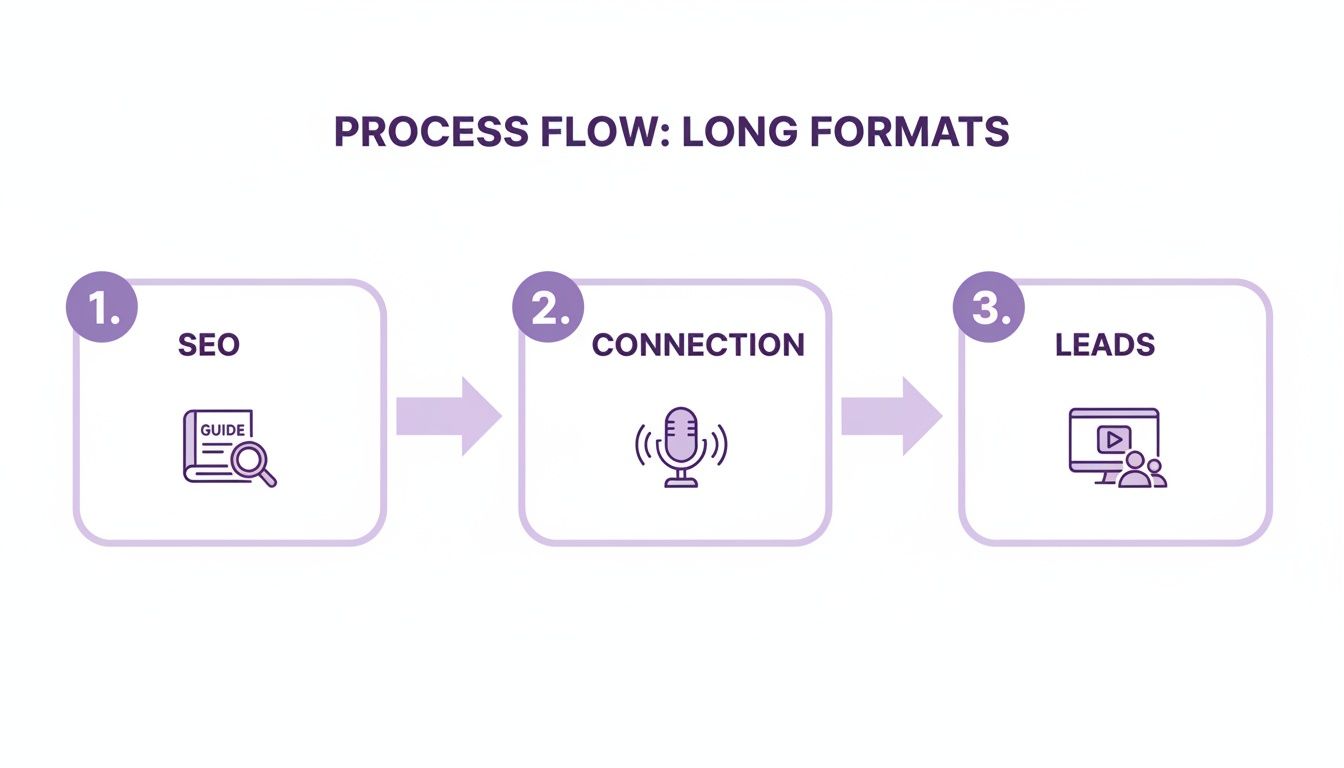
By atomizing their content, the agency fuels its entire marketing pipeline, building authority and grabbing attention on every platform that matters.
The result? Instead of one piece of content, they now have a library of over 15 polished, brand-ready videos tailored for the most popular short-form video platforms. The initial one-hour investment is now working for them around the clock, driving engagement and building authority.
To really get the most out of your long-form assets, using dedicated content repurposing tools is a game-changer, especially when you bring AI into the mix. For a deeper look at the tactics involved, check out our guide on advanced content repurposing strategies. This blend of smart strategy and powerful tech is how you build a content engine that just keeps on delivering.
How to Measure Your Content Strategy's Success

Creating a brilliant piece of long-form content and turning it into dozens of killer clips is a game-changer. But that’s only half the story. To really know if it’s working—and to make it even better next time—you have to track the right numbers. This means going way beyond vanity metrics like view counts and digging into data that shows real engagement and business results.
Think of it as a connected ecosystem. The performance of your short-form clips directly feeds the success of your original long-form asset. Every share, comment, and click-through on a repurposed clip is a small win that adds up to a massive return on your initial investment.
Metrics for Your Cornerstone Content
Your main piece of content—the ultimate guide, the deep-dive webinar, the podcast interview—is the sun in your content solar system. Its success is all about its power to attract, hold, and convert a dedicated audience over the long haul.
To understand its real impact, keep a close eye on these key performance indicators (KPIs):
- Organic Traffic Growth: Is your content consistently bringing in new visitors from search engines? That’s a rock-solid sign that you've created something truly valuable that Google and other search engines trust.
- Time on Page / Dwell Time: When people land on your content, do they actually stick around? High average time on page means your material is genuinely engaging, which is a massive signal to search algorithms.
- New Backlinks Earned: Are other credible sites linking back to your guide or video? Each new backlink is like a vote of confidence, boosting your authority and search rankings.
- Qualified Leads Generated: If you have a call-to-action (like "download the ebook" or "book a demo"), how many real leads is it pulling in? This is where you directly tie your content to business growth.
The real magic of a cornerstone asset is its staying power. It isn't a social post that disappears in a day. A great piece of long-form content can pull in traffic and generate leads for months, or even years, becoming a true engine for your brand.
Gauging the Impact of Repurposed Micro-Content
When it comes to the short clips you’ve created for platforms like TikTok, Reels, and Shorts, the goals are a bit different. Here, it’s all about grabbing immediate attention and sparking curiosity to drive people back to your main content. For a more detailed look, you can explore our guide on how to measure content performance for any format.
For your micro-content, you’ll want to track these metrics:
- Engagement Rate (Likes, Comments, Shares): How are people reacting in the moment? A high engagement rate shows your clips are hitting the right notes and starting conversations.
- Average View Duration: Are people watching until the end or swiping away after just a few seconds? This tells you exactly how compelling your short-form storytelling is.
- Shares and Saves: These are pure gold. When someone shares or saves your clip, they’re basically saying, "This is so good, I need to show it to someone or come back to it later."
- Referral Traffic: How many viewers are actually clicking the link in your bio to see the full video or visit your website? This is the metric that closes the loop and proves your clips are doing their job.
A Holistic Content Performance Dashboard
To truly see the full picture, you need to track how your cornerstone content and repurposed clips work together.
Use this template to track the combined impact of your cornerstone content and its repurposed clips with these key metrics.
| Content Type | Key Metric | How to Measure | Goal |
|---|---|---|---|
| Cornerstone Content | Organic Traffic | Google Analytics, SEMrush | Consistent month-over-month growth |
| Cornerstone Content | Time on Page | Google Analytics | Exceeds 3-5 minutes (platform average) |
| Cornerstone Content | Leads Generated | HubSpot, CRM | Track form fills or downloads from the page |
| Repurposed Clips | Engagement Rate | Native Platform Analytics | 3-5% or higher (platform-dependent) |
| Repurposed Clips | Average View Duration | Native Platform Analytics | >60% of total video length |
| Repurposed Clips | Referral Traffic | Google Analytics, Bitly | Track clicks from "link in bio" sources |
By monitoring these KPIs across both long- and short-form assets, you’ll get a clear, data-backed view of what’s working, what isn’t, and where you should double down on your efforts.
Building Your Sustainable Content Engine
It’s time to stop thinking of long-form and short-form content as rivals. They’re not competing; they're a powerful tag team. Your in-depth guides, webinars, and interviews are the foundational pillars—the stuff that builds real trust and solves complex problems for your audience.
Then, you have your short-form videos. Think of them as the amplifiers, taking the best parts of your core message and broadcasting them to entirely new audiences across every social channel imaginable.
This isn’t about piling on more work. It’s about working smarter. With AI-powered repurposing, you can unlock a ridiculous amount of efficiency, transforming a single long-form video into a whole library of engaging clips ready for social media. We dive deeper into this workflow in our guide on how to scale content creation.
By thinking this way, you shift from one-off content projects to building a sustainable, self-fueling engine for your brand.
Start Building Your Engine Today
The real mindset shift is moving away from seeing content as a series of isolated tasks. Instead, start building a system that consistently delivers value.
The key is to view every piece of long form content not as a finish line, but as the starting block for dozens of marketing opportunities. This is how you build a brand that feels like it's everywhere, all without burning out your team.
Don't just create content; build a content engine. Your long-form assets are the fuel, and AI-powered repurposing is the mechanism that distributes that energy, driving growth across your entire brand ecosystem.
Ready to see how this works in the real world? Try this simple challenge:
- Select one of your existing long-form videos—a podcast episode, a recorded webinar, or a customer interview.
- Use an AI tool to run it through analysis and automatically generate a batch of short-form clips.
- Witness firsthand just how fast you can produce a week's worth of high-quality social media content from a single asset.
This small exercise is a perfect illustration of how a modern content strategy functions. It’s all about getting the absolute maximum value from your best ideas and making sure your expertise reaches the widest audience possible.
Frequently Asked Questions
Still have a few questions about making long-form content work for you? Let's clear up some of the most common sticking points so you can get started with confidence.
How Long Should My Long-Form Content Actually Be?
There’s no magic number here. The real goal isn't to hit a specific word count or video length, but to cover your topic so completely that your audience doesn't need to go anywhere else. Let the value you're providing dictate the length.
For example, a blog post that digs deep into a complex topic might naturally end up around 2,500 words because that's what it takes to provide comprehensive value and satisfy search intent. A detailed tutorial video could easily run for 15 minutes or more.
The best measure of "long enough" is simple: have you totally solved the user's problem or answered their question? Aim to be the most definitive resource on the topic, and the right length will follow.
Is Long-Form Content Still Worth It with Short Attention Spans?
Yes, absolutely. It's a common myth that short attention spans have killed off in-depth content. The truth is, short-form and long-form content serve two different, but complementary, purposes.
Think of short-form content as your hook. It's perfect for grabbing attention and getting discovered. But long-form content is where you build the trust and authority that actually leads to conversions. Research confirms that while attention spans are short for low-value content, users will invest significant time in content that deeply educates or entertains them.
It’s all part of the same journey: a short clip on Instagram might be the handshake, but your detailed guide or webinar is the conversation that builds a real relationship.
How Can I Start Repurposing Without a Big Team?
This is where AI-powered tools become a game-changer, especially for solo creators and small teams. Manually chopping up a one-hour video into dozens of compelling short clips is a massive time sink. It’s just not a sustainable strategy.
Modern AI platforms can do the heavy lifting for you. They analyze your long videos, pinpoint the most engaging moments, and automatically generate branded, captioned clips in just a few minutes. This makes a sophisticated content repurposing workflow accessible to anyone, no matter the team size or budget.
Practical Example: A podcaster can upload their latest two-hour interview and get 20+ social-media-ready clips back in minutes. That one recording session just became weeks of promotional content, all without hiring a video editor. It's about multiplying your reach with minimal effort.
What Are the Best Ways to Promote Long-Form Content?
Great promotion is all about using your content to promote itself. First, make sure your main piece is optimized for search engines (SEO). This is your foundation for attracting a steady flow of organic traffic for months or even years to come.
From there, put your repurposed short-form clips to work.
- Post them everywhere: TikTok, Instagram Reels, YouTube Shorts, you name it.
- Always include a clear call-to-action directing people back to the full piece.
- Email your list with a few key takeaways to pique their interest and drive clicks.
- Reach out to others in your industry for potential shares or collaborations.
Ready to stop the manual editing grind and start building a real content engine? You can turn your long videos into a mountain of high-impact clips 10x faster. Try it for free and see the magic for yourself.