So, what exactly is short-form content? Think of it as any piece of digital media—usually video—that’s built for speed. It’s quick, easy to digest, and designed to grab your attention in the seconds it takes to scroll past. The whole point is to land a message or evoke a feeling in under a minute, making an instant impact before the viewer thumbs to the next thing.
Let's break down the core components for a clearer picture.
Here’s a quick summary of what we're talking about:
Short Form Content at a Glance
| Characteristic | Description | Primary Benefit |
|---|---|---|
| Brevity | Typically under 60 seconds. | Captures attention quickly in a saturated environment. |
| High Engagement | Designed for likes, comments, shares, and saves. | Drives virality and rapid audience growth. |
| Mobile-First | Created and consumed on vertical smartphone screens. | Meets users where they are, in a natural format. |
| Algorithmic Discovery | Content is served to users based on interests. | Allows for massive organic reach beyond followers. |
This table shows why short-form isn't just "short video"; it's a completely different way of communicating that's perfectly tuned for how we use our phones today.
The Cultural Shift to Snackable Content
In the endless sea of digital noise, our attention has become the ultimate prize. This scarcity is exactly what sparked the explosion of short-form content. It’s not a deep-dive article; it’s more like a powerful headline that pulls you in, delivers its punch, and lets you get on with your day in a matter of seconds.

This isn’t just about making shorter videos. It represents a massive change in how we consume information altogether. We've gone from planned media consumption, like tuning in for a weekly TV show, to dipping into a constant stream of bite-sized updates whenever we have a spare moment. Short-form content is tailor-made for these "micro-moments"—the time you spend waiting for your coffee or on your morning commute.
The Psychology Behind the Scroll
Why are these short videos so addictive? It's all rooted in brain chemistry. Every quick, entertaining clip gives you a tiny hit of dopamine, the neurotransmitter linked to pleasure and reward. The endless scroll on platforms like TikTok, Instagram Reels, or YouTube Shorts creates a powerful feedback loop that keeps you coming back for more.
This "snackable" approach is perfectly suited to our modern habits. Studies show that the average human attention span has dropped to about 8.25 seconds, making longer content feel like a huge commitment. Short-form content gets rid of that barrier by offering instant gratification with very little effort. Its visual, fast-paced nature is incredibly efficient at getting a point or a feeling across.
Why Mastering Short Form Content Is Essential
The numbers don't lie—this isn't just a fleeting trend. It’s the new language of the internet, and it’s fundamentally changing how people behave online.
This shift means that getting good at short-form content is no longer optional for creators and marketers. It’s a core skill needed to stay relevant and grow. Nothing else can match its power to generate massive reach and engagement.
Just look at the projections. It's estimated that short-form video will make up about 82% of all global internet traffic in the coming years. That’s a staggering number, and it signals a clear preference for content that is concise, visual, and immediately valuable. You can dig into more of the data about these global trends to see just how significant this change is.
This incredible growth is powered by platforms that have perfected the art of discovery. Their algorithms can take a simple video and turn it into a viral hit overnight. For brands, developers, and creators, this opens up a whole new world of opportunity to connect with audiences in a much more dynamic and authentic way.
Choosing Your Platform: TikTok vs. Reels vs. Shorts
Figuring out where to post your short-form content isn't just about picking an app. It's about choosing the right ecosystem for your brand. The big three—TikTok, Instagram Reels, and YouTube Shorts—each have their own unique algorithm, audience culture, and strategic purpose. Getting these differences is the first step to making content that actually hits your goals.

Think of it like this: you wouldn't book a stand-up comedian for a classical music hall. The venue has to match the performance. In the same way, your platform choice needs to align with your content's tone and style if you want to connect with the right crowd.
TikTok: The Unmatched Discovery Engine
At its core, TikTok is a discovery platform. Its algorithm is a force of nature, designed to push content to users based on their raw interests, not just the accounts they follow. This makes it an incredible tool for reaching totally new audiences and catching fire organically.
The culture on TikTok is all about trends, authenticity, and being a little weird. Raw, unpolished videos often do much better than slick, corporate-looking ones. With over 1.5 billion monthly active users, the audience is massive, engaged, and always ready to jump on a new challenge, duet, or stitch. It’s a true breeding ground for virality.
Strategic Goal: Go with TikTok if your main objective is maximum brand awareness and viral potential. It's the place to launch trends, show off your brand's personality, and connect with a younger crowd that craves genuine entertainment over a sales pitch.
Instagram Reels: The Aesthetic Community Builder
Instagram Reels lives inside a much larger social network. While it has a discovery algorithm, it’s also tied to a user’s existing social circle—the people they already follow and engage with. This changes the game completely, as your content needs to serve both new and existing followers.
Reels tend to favor more aesthetically pleasing and polished content. Think beautiful B-roll, seamless transitions, and videos that look right at home on a curated feed. To really nail your strategy, it helps to understand the nuances between Instagram Reels vs. Posts and how each format works toward different goals. Reels are perfect for deepening the relationship with your current audience while attracting new followers who love a good visual story.
- Best for: Brands and creators who already have a solid footing on Instagram.
- Content style: Visually driven, inspiring, and often centered around lifestyle topics.
- Key advantage: You can use your existing follower base to give your content an initial boost.
For a deeper dive into platform-specific tactics, our guide to creating short-form videos for TikTok and Reels breaks it all down.
YouTube Shorts: The Search-Driven Knowledge Hub
YouTube Shorts has a secret weapon: its direct line to the world's second-biggest search engine. While it can definitely play the trend game, its real power is in answering questions people are actively searching for.
This makes Shorts a beast for educational, how-to, and evergreen content. A quick video that explains a tricky concept can show up in search results for months—or even years—driving steady traffic long after you’ve posted it. This searchability gives Shorts a much longer shelf life than the fast-moving content on TikTok or Reels.
Strategic Goal: Focus on YouTube Shorts if you want to build authority, provide real value, and create durable, searchable content. It’s the ideal platform for anyone whose content is designed to be a long-term asset.
Content Formats That Actually Get Engagement
Alright, let's move from the "what" and "why" of these platforms to the part that really matters: What kind of short-form content actually makes people stop scrolling? Trends are fleeting, but certain formats just work because they connect with us on a human level. They solve a problem, tell a story we see ourselves in, or just feel real.
Getting a handle on these tried-and-true formats is your key to making content that doesn't just get views, but gets people talking and clicking. It’s not about having the slickest production; it's about picking a framework that delivers value in seconds.
Here are the heavy hitters that consistently perform.
Educational How-To Clips
One of the fastest ways to build credibility is to teach something useful. "How-to" videos are gold because they solve a specific problem for your audience, instantly making you a valuable resource. The trick is to keep it laser-focused on one single, achievable outcome.
Practical Example: A software company could drop a 30-second clip revealing a little-known keyboard shortcut. A chef could show the right way to dice an onion in under 45 seconds. People save and share this stuff because it’s genuinely helpful, and they'll want to come back to it later.
The big idea here is simple: teach, don't just tell. People are actively searching for answers, and a quick, clear tutorial is the most direct way to give them what they want. That’s how you build trust and become the go-to expert.
Authentic Behind-the-Scenes Looks
Let’s be honest, people are nosy. We love seeing what goes on behind the curtain, and that curiosity is a powerful tool for building a real connection. Behind-the-scenes (BTS) content shows the unpolished, human side of your work, your process, or your company culture. It’s the perfect antidote to slick, impersonal marketing.
Practical Example: An e-commerce owner could share a quick video of them carefully packing an order, or a design team could show a chaotic (but productive) brainstorming session. These little glimpses make your brand feel human and relatable. In fact, research shows that authenticity is a huge deal for consumers, with 86% of people saying it’s a key reason they support a brand.
This is how you turn an audience into a community—by making them feel like they're on the inside.
Leveraging Trending Audio and Memes
Jumping on a trending sound is like joining a conversation that’s already in full swing. When a song or audio clip is blowing up, the algorithm is primed to push content using it to a much bigger audience. It's one of the quickest ways to expand your reach.
But just slapping a popular song onto a random video won't cut it. The magic happens when you creatively twist the trend to fit your world.
- A financial advisor could use a trending sound about "bad decisions" to highlight common investing mistakes.
- A real estate agent might use a popular audio clip about "dream homes" to give a tour of a new listing.
- A developer could adapt a meme to show the pure relief of finally fixing a stubborn bug.
The goal is to participate in the platform's culture in a way that feels genuine to your brand, not like you're just chasing clout.
Immersive POV Storytelling
Point-of-view (POV) videos are so effective because they put the viewer right in the middle of the action. This format is all about creating an immersive experience. By using simple text overlays like, "POV: You’re unboxing your first order from us," you can walk someone through an experience from their own perspective.
It's a fantastic way to demonstrate the value of a product or service. A fitness coach could create a "POV: Your first personal training session" video to show potential clients what to expect and calm their nerves. This storytelling approach builds empathy and helps people visualize themselves as your customer, making it an incredibly powerful way to convert viewers.
Driving Real Business Growth with Short-Form Video
Going viral is a great feeling, but the real magic of short-form content is what it can do for your bottom line. It’s grown up from being just a fun tool for brand awareness into a serious engine for sales, lead generation, and finding new customers. The trick is to stop thinking of these videos as just entertainment and start seeing them as the first handshake in your customer's journey.
When you connect creative, engaging content directly to measurable business goals, you start turning passive viewers into active buyers. Nowhere is this more obvious than in social commerce, where the gap between seeing a product and buying it has all but vanished.
From Views to Revenue
Today's platforms have built-in features that create a super smooth path from a video to your checkout page. This basically turns your content into an interactive storefront, dramatically shortening the time it takes for someone to decide to buy.
-
In-App Shopping Features: If you're an e-commerce brand, you can now tag products right in your Instagram Reels or use TikTok's "Shop Now" button. Someone can see a product they love in a video, tap a tag, and buy it without ever leaving the app. It's that simple.
-
Building Trust and Showcasing Value: Think about it—a 45-second video showing how your product solves a real problem builds way more trust than a flat, static product description. This kind of visual proof makes your value crystal clear and nudges potential customers much closer to making a purchase.
This direct line to commerce is changing how brands think about their marketing spend. The influence of short-form content is now huge, and it's completely reshaping the e-commerce world. In fact, social commerce sales, fueled by features like TikTok's 'Shop Now' and Instagram’s product tags, have exploded, hitting around $9.7 billion globally. For a deeper dive into these trends, you can discover more insights on the long-term impact of visual content.
Practical Examples of Driving Growth
Let's get practical. How can different businesses actually use this? The goal is to shift your focus from simply chasing views to encouraging actions that actually generate revenue.
Practical Example: An indie skincare brand films a 30-second Reel showing off the texture and application of a new serum. They hop on a trending audio track to grab attention, but the video itself is all about the product's benefits. By adding a direct product tag, they let people buy it on the spot, turning a moment of mindless scrolling into a sale.
This approach effectively makes your social media feed a direct sales pipeline. Suddenly, high engagement isn't just a vanity metric; it's a real indicator of sales potential. To make these efforts count, it's crucial to understand how to increase social media engagement, as that engagement is the fuel for your sales engine.
When you create content that entertains, educates, and makes buying easy, your short-form video strategy becomes a reliable driver of business growth. Every single video is a new opportunity—not just to get noticed, but to win a new customer.
Measuring the Metrics That Truly Matter
So, how do you actually know if your short-form content is working? It's easy to get excited about a video that racks up a ton of views, but that number alone doesn't paint the full picture. To really gauge your impact, you have to look beyond the surface-level stats and zero in on the key performance indicators (KPIs) that prove you're building a real connection with your audience.
Metrics like views and likes can be deceiving. Sure, they tell you people saw your content, but they don't tell you if they actually cared about it. The real gold is in the metrics that show deep engagement and prove your video was compelling enough to make someone stop scrolling.
Moving Beyond Vanity Metrics
The most meaningful data comes from understanding how viewers behave from the second your video starts until the moment it ends. These are the numbers the algorithms care about because they signal quality content that keeps people on the platform longer.
Here are the metrics that really move the needle:
- Average Watch Time: This is the average length of time people spent watching your video. A longer watch time tells the algorithm your content is sticky and worth pushing out to a wider audience.
- Completion Rate: This is the percentage of viewers who stuck around for the entire video. A high completion rate is one of the strongest signals you can send that your content was gripping from start to finish.
- Shares and Saves: These actions are worth far more than a simple like. A share means your content was so valuable that someone felt compelled to pass it along, while a save shows they wanted to keep it for future reference.
Getting a handle on how to measure social media engagement is the key to connecting your creative work to real-world results and making smarter choices for your next video.
Your goals should dictate which metrics you prioritize. Are you trying to build brand awareness or drive direct sales? This simple question changes everything.
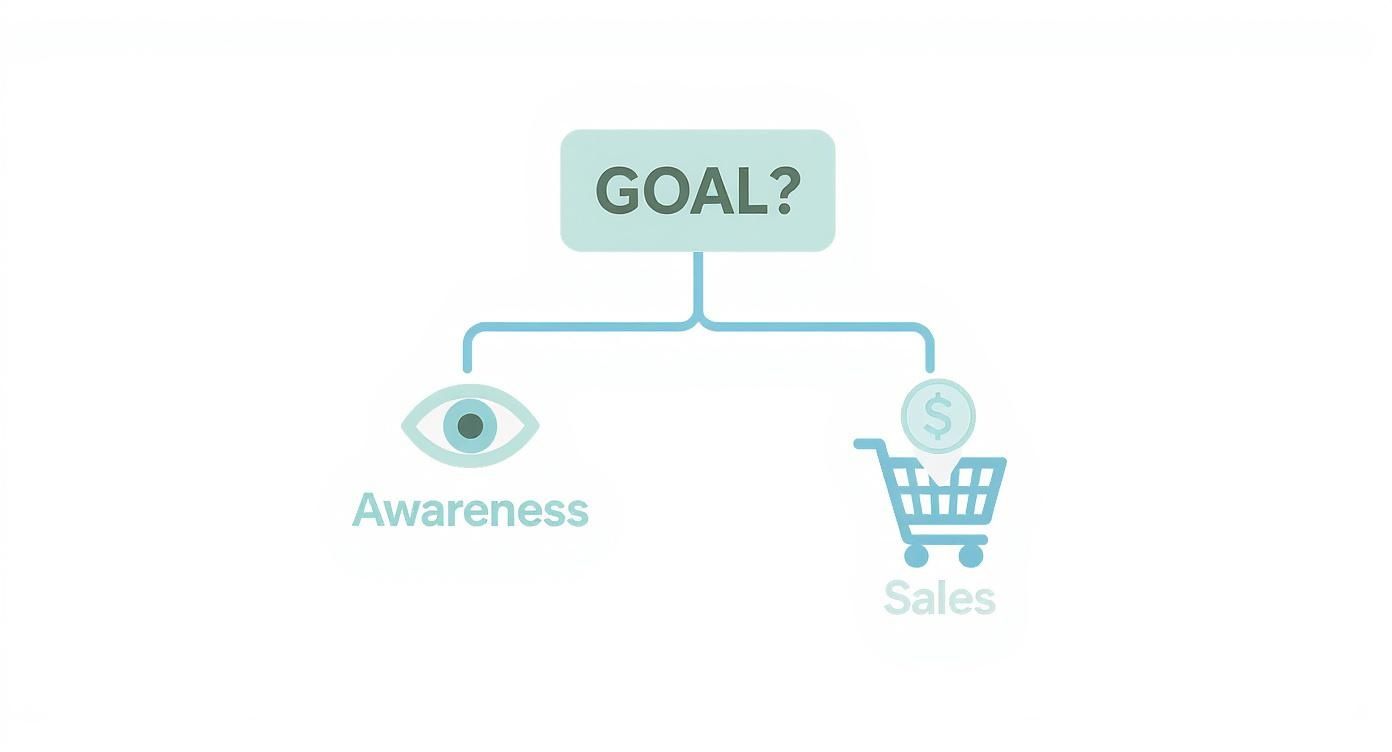
The takeaway here is simple: awareness campaigns live and die by reach and watch time, while sales-focused campaigns need to obsess over clicks and conversions.
Aligning KPIs With Your Business Goals
The metrics you track must always map directly back to a specific business objective. Chasing the wrong KPIs is a surefire way to burn through your time and budget. If your goal is to generate leads, a video with a million views but zero link clicks is ultimately a failure.
Selecting the right metrics for your strategic goals is critical. This table breaks down which KPIs to focus on based on what you're trying to achieve.
Mapping Business Goals to Short Form Content KPIs
| Business Goal | Primary KPI | Secondary KPIs | Why It Matters |
|---|---|---|---|
| Brand Awareness | Reach & Impressions | Average Watch Time, Completion Rate | Your main goal is to get in front of as many relevant eyeballs as possible and hold their attention. |
| Community Engagement | Shares, Saves & Comments | Follower Growth, Mentions | These actions show you're building a loyal audience that finds your content valuable enough to interact with. |
| Lead Generation | Click-Through Rate (CTR) | Landing Page Views, Form Submissions | This directly measures how effective your content is at moving viewers off the platform and into your sales funnel. |
| Direct Sales | Conversion Rate | Add to Carts, Revenue per Video | This is the bottom-line metric, tracking how many viewers actually completed a purchase after seeing your content. |
By aligning your goals and KPIs, you can move from guessing to knowing, building a data-driven content strategy that delivers measurable growth for your business.
Building an Efficient Content Creation Workflow
The best short-form content looks effortless, but behind the scenes, it’s all about having a smart, repeatable system. If you’re just creating videos on the fly, you’re setting yourself up for burnout and inconsistent posting—the two biggest growth killers on any platform.
The trick is to stop thinking like an artist creating one-off masterpieces and start thinking like a factory manager running a streamlined assembly line. Every part of the process, from the initial spark of an idea to hitting "publish," needs to be intentional and efficient.

This kind of system doesn't just save you a ton of time; it also builds the consistency your audience craves. They know when to expect new content from you, and you never have to scramble for an idea again.
The Power of Batching Your Content
One of the most powerful workflow upgrades you can make is content batching. Instead of the start-stop-start-stop chaos of making one video at a time, you dedicate focused blocks of time to a single task. It keeps you in the zone and is way more productive.
Here’s how a simple batching system breaks down:
- Ideation Day: Block out a couple of hours to brainstorm a month's worth of ideas. Look at your content pillars, see what's trending, and dig into what your audience is asking.
- Scripting Session: Take those ideas and flesh them out. You don't need a perfect, word-for-word script. Just nail down the hook, your main points, and a clear call to action.
- Filming Block: This is the big one. Set aside half a day, get your camera, lights, and mic set up once, and film everything for the next few weeks. The efficiency gain here is massive.
- Editing and Scheduling: Now, edit all that footage in one go. Once they're done, load them into a scheduler and plan out your content calendar.
Suddenly, a frantic daily task becomes a well-managed monthly project. This frees up so much mental energy to focus on strategy and community engagement.
Smart Repurposing From Long-Form to Short Clips
What if I told you your best content ideas already exist? The ultimate workflow hack is repurposing your long-form content—think podcasts, webinars, or long YouTube videos—into dozens of bite-sized clips. This strategy wrings every last drop of value out of work you've already done.
Think of a one-hour podcast episode as a goldmine. It’s packed with stories, actionable tips, and powerful quotes. Each one of those moments can be a standalone, high-impact 60-second video for TikTok, Reels, or Shorts.
This isn’t just about saving time on brainstorming and filming; it also keeps your messaging perfectly aligned across all your channels.
And if you want to put this on hyperdrive, you can explore how to repurpose long videos into engaging short clips with AI. These tools are built to do the heavy lifting for you.
AI-powered platforms can scan your long video, pinpoint the most engaging highlights, and even add those slick, dynamic captions everyone loves. What used to be a tedious, multi-hour editing slog can now be done in minutes. You get a steady stream of high-quality short-form content with a fraction of the effort.
Got Questions About Short-Form Content? We've Got Answers.
Jumping into short-form video can feel like learning a new language. You're not alone if you're wondering where to even start. Let's tackle some of the most common questions that pop up for creators and marketers alike.
"Seriously, How Often Should I Be Posting?"
Everyone wants a magic number, but the honest answer is: consistency beats frequency every single time.
Think of it this way—posting three genuinely interesting, well-made videos a week will do more for you than seven rushed clips just to hit a daily quota. The real goal is to find a pace you can actually maintain without burning out or sacrificing quality.
A great starting point is two or three times a week. Get into that rhythm, see what your audience responds to, and then, if you have the capacity, try bumping it up. The idea is to build a reliable presence, not just flood the feed.
"Do I Really Have to Be On Camera?"
Nope. Not at all. In fact, some of the most viral content out there never shows a face. This is where you can get really creative with your storytelling.
There's a huge myth that you have to be a charismatic, on-camera personality to win at short-form video. The truth is, content built around product demos, screen recordings, text-driven stories, or even user-generated clips can be incredibly powerful.
Practical Example: A software company, instead of having a spokesperson, could create a snappy screen recording that walks you through a cool, time-saving feature. Add some clear text overlays pointing out the steps, and you've got a winner. Since research shows 71% of viewers make a snap judgment in the first few seconds, a video that gets straight to the point is often more effective than one with a lengthy talking-head intro.
"What Tools Can I Use That Won't Break the Bank?"
You don’t need a fancy studio or an expensive software subscription to make great videos. The best camera you have is the one in your pocket. For editing, a few free or low-cost apps will get you 99% of the way there.
Here are a few solid options to get you started:
- CapCut: This free mobile editor is a powerhouse. It’s packed with effects, easy text tools, and a library of trending audio.
- Canva: Perfect for creating eye-catching graphics, animated text, and simple video templates when you need something polished.
- InShot: Another fantastic and intuitive mobile app for all the basics—trimming clips, adding music, and quick color adjustments.
These tools are more than enough to produce clean, professional-looking content without spending a dime.
Ready to create high-impact short clips from your long videos without the manual effort? AI can automatically find the best moments, add dynamic captions, and get your content ready for social media in minutes. Start your free trial and create clips 10x faster.