A video doesn't just "go viral" by accident. It's the result of hitting a sweet spot where a powerful emotional hook, built-in shareability, and platform discoverability all align perfectly. It's this fusion of human psychology and algorithmic favor that turns a simple clip into an overnight sensation.
The goal is to create something people feel an almost instinctual need to share, which then sends all the right signals to the platforms, telling them, "Hey, show this to more people!"
Unlocking the Viral Triangle
Ever scroll through your feed and wonder why one video has a million views and another, seemingly similar one, has only a hundred? It's not just luck; there’s a science to it. I like to think of it as a three-legged stool. If one leg is shaky, the whole thing comes crashing down. Viral content works the same way.
These three critical components form what I call the "Viral Triangle." For a video to truly take off, each element has to pull its weight.
- Emotion: The video has to hit the viewer with an immediate, strong feeling.
- Shareability: It needs to be something people feel a genuine urge to send to their network.
- Algorithm: The content must satisfy what the platform's algorithm is looking for, prompting it to push the video out to a massive audience.
This is what it looks like when those three forces come together.
As you can see, true virality happens right in the middle, where these pillars intersect. That's the magic zone where a simple clip becomes a cultural phenomenon.
To give you a clearer picture, here's a quick breakdown of these core pillars.
The Three Pillars of Virality at a Glance
| Pillar | Primary Driver | Key Action for Creators |
|---|---|---|
| Emotion | Human Psychology | Elicit a strong, immediate feeling like joy, surprise, or awe. |
| Shareability | Social Connection | Make the content relatable and easy for viewers to pass along. |
| Algorithm | Platform Signals | Optimize for watch time, engagement, and platform-specific cues. |
Mastering the interplay between these three areas is what separates fleeting content from viral hits.
Emotion: The Fuel of Virality
Let's be clear: emotion is non-negotiable. If your video doesn't make someone feel something, it’s dead in the water. It won’t get shared, period.
Content that triggers what psychologists call "high-arousal" emotions—think awe, intense joy, genuine surprise, or even righteous anger—is far more likely to get passed around. While positive content generally has an edge, any powerful feeling can be the rocket fuel.
Practical Example: The videos of soldiers returning home to surprise their families go viral time and time again. They tap into universal emotions of love, relief, and happiness. Watching one makes you feel good, and you immediately want to share that feeling with someone else.
The most shareable content relies on a simple psychological trigger: it makes the viewer feel something so strongly that sharing it becomes a way to express their own identity or connect with their community.
Shareability: The Catalyst for Growth
A powerful emotional response is what creates the desire to share. People pass content along for all sorts of reasons: to look in-the-know, to offer help, to make their friends laugh, or simply to signal they're part of a group. A video's shareability is tied to how easily its message can be transmitted and how broadly it resonates.
This is where practical elements like trending audio or a universally relatable premise come in. When a creator on TikTok uses a popular sound, they're plugging into an ongoing cultural conversation. It instantly makes their content more familiar and primed for sharing. With video now comprising over 82% of all internet traffic, these short, easy-to-digest clips are what's driving culture forward.
Think of this section as your foundational map. As we dig deeper, we'll explore each corner of the Viral Triangle, giving you the specific strategies you need to master emotion, engineer for shareability, and finally, win over the algorithms that decide what the world sees next.
Cracking the Code of Human Emotion
Long before any algorithm gets a say, your video has to pass the human test. A video doesn't just randomly blow up because a machine decided it should; it catches fire because it makes people feel something so strongly that they have to act. This is the absolute bedrock of virality. No emotional spark, no fuel for the fire.
Think of it this way: your video is the match, and the viewer's emotion is the kindling. But some emotions are like gasoline. We call these high-arousal emotions—the kind of feelings that snap us out of a passive scroll and make us hit that share button.

The Big Three Viral Emotions
While you can connect with people in countless ways, a few specific emotions are consistently responsible for massive waves of sharing. If you can tap into these psychological triggers, you're halfway to understanding virality.
- Awe and Wonder: Think of those stunning nature shots, unbelievable human feats, or mind-bending science facts. Awe makes us feel like we're part of something bigger, and we instinctively want to pull others into that feeling with us.
- Laughter and Joy: Humor is the ultimate social glue. A hilarious, relatable skit or a genuinely heartwarming moment creates an instant positive reaction. People share laughter to spread that good feeling and reinforce their connections.
- Outrage and Anger: It might not always be positive, but outrage is an incredibly powerful high-arousal emotion. Content that shines a light on an injustice or taps into a shared frustration can spread like wildfire as people share it to say, "See? I'm not the only one who's mad about this!"
While positive content generally gets shared more often, any of these high-arousal emotions can power a viral hit. It’s not about being positive or negative; it’s about the intensity of the feeling you create.
A New York Times study on their most-emailed articles found that content inspiring high-arousal emotions like awe, anger, or anxiety was 30% more likely to make the list. The same principle applies directly to video.
The Undeniable Power of Relatability
Beyond those intense, peak emotions, there's another force at play that's just as potent: relatability. When you create a video that makes someone think, "I've been there," you've made them feel seen. That sense of connection is a massive driver for sharing.
If someone sees a video that perfectly captures a niche frustration at the grocery store, a quirky family argument, or an everyday awkward moment, their first impulse is to send it to the one person who will get it. That’s social validation in its purest form.
Practical Example: The Relatable Skit
Just look at the thousands of skits on TikTok or Instagram Reels that poke fun at remote work life. Imagine a creator acting out the chaos of trying to look professional on a Zoom call while their dog is barking its head off in the background.
- The Hook: It instantly connects with millions of people who've lived that exact moment.
- The Emotion: It triggers a mix of amusement and the comforting feeling of a shared struggle.
- The Share: Viewers don't hesitate to drop it in their work chat with a caption like, "This is literally us every day."
That’s how relatability manufactures virality. The content becomes a sort of inside joke or a shorthand for a shared experience, turning it into the perfect thing to pass along.
Crafting Content with Emotional Intent
To put this all into practice, you have to stop hoping for an emotional reaction and start designing for one. Before you even think about hitting record, ask yourself one simple question: "What do I want my audience to feel?"
Are you going for a gut-busting laugh? A moment of pure inspiration? A knowing nod of agreement? Every single choice you make—the music, the editing pace, the words you use, the shots you get—has to serve that one emotional goal. This focus is what separates a video that gets a polite "like" from one that gets forwarded to a viewer's entire contact list, kicking off the chain reaction you're looking for.
How Social Media Algorithms Decide What Goes Viral

If human emotion is the fuel for a viral video, then the platform’s algorithm is the engine. To get anywhere, you need to understand what makes that engine fire on all cylinders.
Platforms like TikTok, Instagram, and YouTube aren't just randomly showing videos. They're running incredibly sophisticated systems with one core mission: keep people watching for as long as possible. To do this, they act like a talent scout, constantly auditioning every single video you post.
A video that gets a standing ovation from its first small audience gets pushed to a bigger stage. One that flops? It gets pulled almost immediately. Your job is to create content that passes that initial audition with flying colors.
The Key Signals That Algorithms Love
Not all engagement is created equal. Think of it like a scoring system where some actions are worth way more points than others. A simple "like" is a nice pat on the back, but it's a low-effort tap that doesn't tell the algorithm much.
The real gold is in the actions that show a viewer is genuinely invested in your content. These are the signals that scream, "This is great, show it to more people!"
- Shares and Saves: A share is the ultimate stamp of approval. Someone is putting their own reputation on the line by sending your video to a friend or posting it on their own profile. A save is just as powerful—it means your content is so good, they want to come back to it again and again.
- Comments: A lively comment section is a sign of a healthy, engaged community. When a video sparks a real conversation, it keeps people on that piece of content longer, which is exactly what the platform wants.
- Watch Time and Completion Rate: This might be the most important signal of them all. If people are watching your entire video, you've won. A high completion rate on a short video is a massive vote of confidence, telling the algorithm your content is compelling from start to finish.
The Algorithm's Test Run: Your video doesn't get shown to millions right away. First, it goes to a small, hand-picked test audience. How this group reacts determines everything. If they love it, the algorithm expands its reach. If they scroll past, it dies.
From Small Test Groups to Massive Reach
So, you just hit "post." What happens next? The algorithm immediately pushes your video to a small batch of a few hundred users it thinks will like it. Then, it watches them like a hawk.
Did they watch it all the way through? Did they share it in the first hour? Did it spark any comments? If the answers are "yes," the algorithm sees a potential hit.
It then rolls your video out to a slightly larger group of people. If that group also reacts well, it expands the audience again. This is the snowball effect in action, and it's how a video goes from a handful of views to millions overnight. That’s why those first few hours are absolutely critical—a strong start can trigger this algorithmic landslide. While each platform has its own secret sauce, this core process is remarkably similar across the board. You can see this in action by delving into the Twitter algorithm and how it surfaces content.
Why Community Signals Matter Most
These days, algorithms are looking for more than just a quick laugh. They're prioritizing content that actually builds a community and gets people talking to each other.
Think about features like Duets, Stitches, or video replies. They aren't just fun gimmicks; they're powerful signals that your content is inspiring other people to create. When someone uses your audio or builds off your video, it creates a web of content that keeps everyone more deeply engaged.
An active creator who replies to comments is also sending a huge positive signal. Ultimately, algorithms want to find content that acts as a conversation starter. When you create videos that encourage this kind of back-and-forth, you’re playing the game on the platform’s terms—and dramatically boosting your chances of going viral.
Tapping into Trending Audio and Short Formats
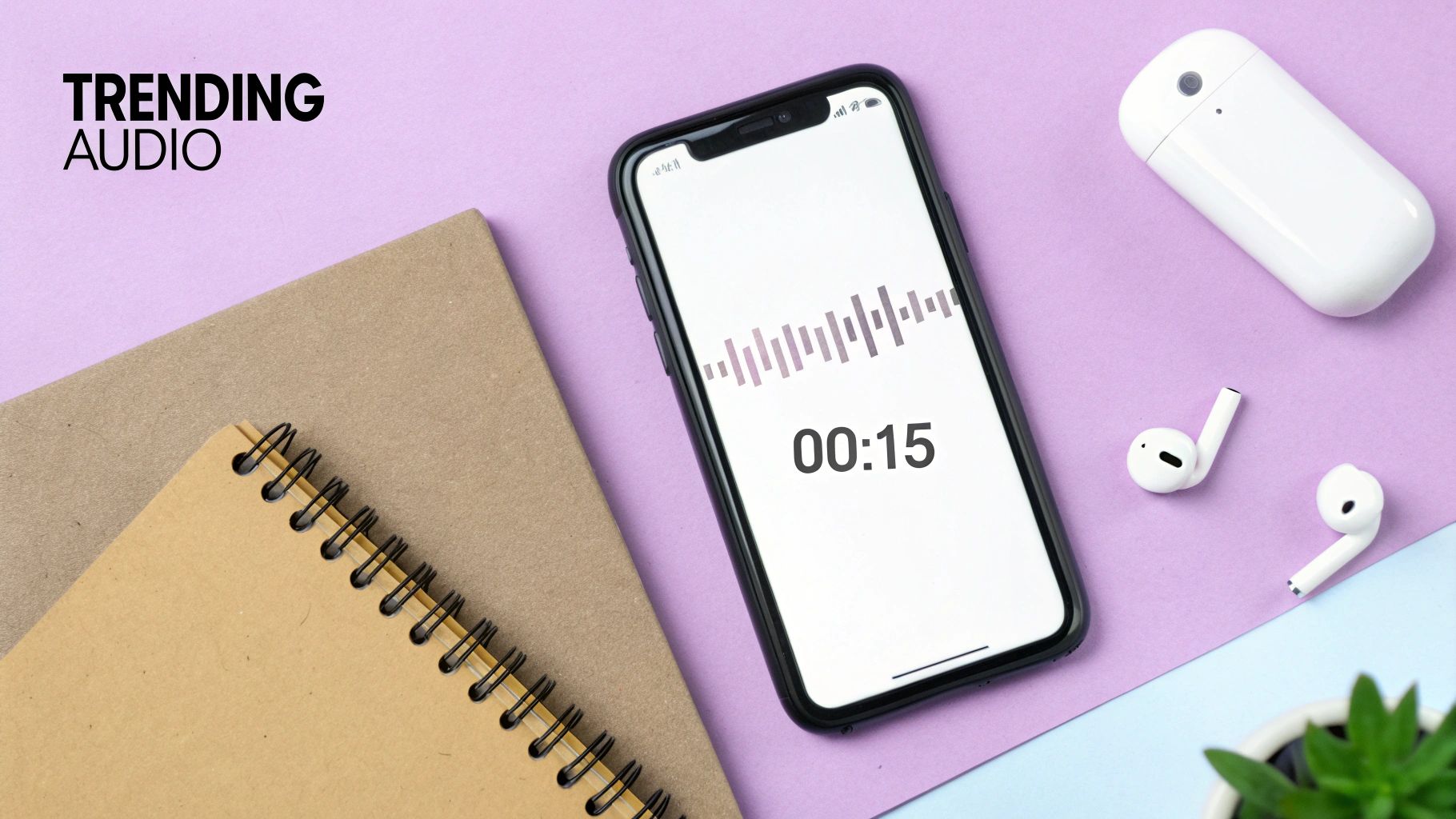
On platforms like TikTok and Instagram Reels, what people hear is often just as critical as what they see. If human emotion is the fuel and algorithms are the engine, then trending audio and short formats are the turbochargers. They give your content an immediate, powerful boost, essentially acting as an algorithmic shortcut to getting discovered.
When you use a popular sound, you’re doing more than just adding a background track. You're plugging your video directly into a massive, ongoing conversation. The algorithm instantly flags the audio, knows exactly who likes it, and starts pushing your video to people who have already watched, liked, or shared other videos with that same sound. It's a huge leg up for getting on the coveted For You Page.
Why Trending Audio is a Viral Catalyst
Think of a trending sound as a pre-approved pass to a much bigger audience. It's a clear signal to the platform that your content is relevant right now. This effect can be ridiculously powerful, sometimes launching a niche video into the mainstream for no other reason than it was paired with the perfect audio.
Some of the biggest viral hits are driven almost entirely by the right sound skyrocketing their discoverability. For instance, the popular "Oh No" audio by Capone has been used in over 22 million videos on TikTok alone. When a user creates a video with that sound, the platform's algorithm has a massive dataset of viewers who have previously engaged with it, providing a ready-made audience.
This creates a huge opportunity. You can take a snippet from something longer, like a podcast or webinar, and completely change its trajectory. Find a trending sound that matches the clip's vibe, and you can introduce your best ideas to a whole new audience that never would have found the original.
The Psychology of the Infinite Scroll
Beyond just the audio, the very nature of short-form video has rewired how we consume content. Videos under 60 seconds are perfectly built for the way our brains work now, trained by the "infinite scroll" to crave quick, satisfying hits of information or entertainment.
The goal of a short clip isn't to tell the entire story. It's to deliver one powerful moment—a laugh, a realization, a helpful tip—as fast as possible. A high completion rate on a short video is one of the strongest positive signals you can send to the algorithm.
This fast-paced world rewards content that gets to the point immediately. You have maybe two or three seconds to make an impression before someone swipes away. This is why a strong visual hook paired with compelling audio is such an unstoppable combination. For a deeper dive into crafting a winning strategy, check out our complete guide on https://swiftia.io/short-form-content/.
Bringing It All Together for Maximum Impact
The real magic happens when you nail the trifecta: a powerful visual, the perfect trending sound, and a sub-60-second format. This is the blueprint for so many viral videos.
Practical Example: The Podcast Repurposing Play
- The Content: A podcaster shares a killer 30-second insight about a common business mistake.
- The Audio: Instead of just the raw voiceover, they layer a subtle, trending instrumental track underneath. It’s popular enough to be recognized but not so loud that it distracts from the message.
- The Result: The algorithm picks up on the trending sound and starts distributing the clip. People, initially drawn in by the familiar music, stick around to hear the genuinely useful tip. The video's shareability goes through the roof because it packages valuable advice in a culturally relevant wrapper.
To really nail this, you can use a TikTok Caption Generator to write descriptions that also tap into what's currently popular. The secret is to jump on emerging audio trends before they peak, giving your content the longest possible runway to fly.
Putting Your Content Creation on Fast-Forward with AI Editing
Let's be honest: trying to make a viral video is a volume game. You can have the best idea in the world, but if it doesn't land, you need another one ready to go. The more high-quality ideas you can test, the higher your chances of striking gold. This is where speed becomes your secret weapon, and why AI-powered editing tools are no longer a "nice-to-have"—they're essential.
The old-school approach of a human manually scrubbing through hours of footage just can't keep up. The real opportunity today is in slicing and dicing your long-form content—think podcasts, webinars, or interviews—into dozens of punchy, shareable clips. This strategy lets you see what your audience actually connects with, without betting the farm on a single video that took days to produce.
Turning Hours of Work into Minutes of Magic
The magic of AI editing is how it automates the most soul-crushing parts of the job. Tasks that used to eat up an entire afternoon for a skilled editor can now be done in minutes. This frees you and your team to focus on what really matters: brainstorming great ideas and refining your strategy.
It's no secret that short-form videos (under 60 seconds) are the kings of the internet right now. Since late 2021, engagement on Instagram Reels has shot up by 25%, and more than half of all YouTube users are watching Shorts every single month. With video making up a staggering 82% of all internet traffic, the demand is clear. AI tools can take a long recording and generate TikTok-ready clips with smart speaker detection and crisp 4K quality far more efficiently than manual methods.
This is where Swiftia changes the game. Our AI scans your content and pinpoints the most engaging, viral-worthy segments for you. That one-hour podcast? It can instantly become 20-30 potential bangers, letting you test more ideas in a day than you used to in a month. While other tools may only offer basic cutting, our platform is designed to identify conversational highlights and emotional peaks, ensuring the clips it suggests have the highest potential for impact.
The real win here isn't just about moving faster. It's about working smarter. AI doesn't just help you make more content; it helps you find and create the right content—the stuff that's actually built to succeed.
The AI Features That Actually Fuel Virality
So, how does it work? Specific AI features are designed to tackle the very things that make a video pop. They're built to maximize audience retention and trigger the engagement signals that platform algorithms are hungry for.
Here are a few of the game-changing features:
- Automated Filler Word Removal: In a 30-second video, every single second counts. AI can instantly find and snip out all the "ums," "ahs," and awkward pauses. The result is a clean, confident, and professional video that keeps people glued to the screen.
- Dynamic Caption Animation: Since 85% of Facebook videos are watched on mute, your captions have to do the heavy lifting. AI-powered tools create animated, eye-catching text that makes your message impossible to miss, even with the sound off.
- Predictive Virality Scoring: Not all clips are created equal. Some AI tools can even analyze your video and give it a "virality score," helping you decide which clips to push and which to leave on the cutting room floor.
- Multi-Language Support: A truly viral video knows no borders. With AI-driven translation and voiceovers, you can take your best-performing content and instantly adapt it for a global audience, massively expanding its potential reach.
These aren't just fancy editing tricks; they're strategic tools. To see how different platforms stack up, check out our guide on the best AI tools for video editing. By letting the AI handle the tedious technical work, you get to focus on the human element—the creativity, emotion, and storytelling that ultimately make people want to hit "share."
Your Practical Checklist for Creating Viral Videos
Knowing the theory is one thing, but actually doing it is what separates the wannabes from the winners. This checklist boils down everything we've talked about into a practical, step-by-step game plan. Think of it as your roadmap to making sure every video you create has a real shot at taking off.
We'll walk through the entire process, from that first spark of an idea all the way to getting it in front of as many people as possible.
Pre-Production: Building Your Foundation for Success
Before you even dream of hitting the record button, the groundwork you lay here will make or break your video's potential. Getting this stage right is absolutely crucial.
- Ideate with a Purpose: Don't just make a video. Solve a problem, answer a question, or tap into a powerful feeling. Ask yourself: "Will this make someone laugh out loud, feel understood, or see something familiar in a totally new way?"
- Scout for Trends: See what audio, formats, and challenges are already popping off on platforms like TikTok and Instagram. The trick isn't just to copy a trend but to find one that genuinely fits what you want to say.
- Craft Your Hook: Your first 3 seconds are everything. Plan them with surgical precision. Kick things off with a bold claim, a surprising visual, or a question that people can't help but want the answer to.
Practical Example: A creator making a cooking video doesn't start with "Hi everyone, today we're making pasta." They start with a shot of them throwing a failed dish in the trash, with on-screen text that says, "Here's the mistake that's ruining your pasta sauce." It's an immediate hook that promises to solve a problem.
Production and Post-Production: Nailing the Execution
This is where your vision becomes reality. Your entire focus should be on grabbing attention immediately and keeping it clamped down until the very end.
- Look and Sound Good: Clean lighting and crisp audio aren't negotiable anymore; they're the bare minimum. People have zero patience for content that looks or sounds bad and will swipe away without a second thought.
- Keep the Pace Punchy: Your editing needs to be quick and energetic. Cut out every single awkward pause and filler word. You're creating a high-energy experience that respects the viewer's time.
- Use Captions That Pop: Add animated text to emphasize your key takeaways. A ton of people watch with the sound off, so your on-screen text has to carry the story all by itself.
Distribution and Promotion: Getting Eyes on Your Work
You've made a fantastic video. Now what? A smart launch strategy can be the difference between a few views and a viral hit.
- Time It Right: Post when your audience is actually online and scrolling. Dive into your analytics to pinpoint the peak times your specific followers are most active.
- Write for Shares: Your caption should do more than just describe the video; it should spark a conversation. Try ending with a direct question or a clear call-to-action (CTA) like, “Tag someone who needs to see this.”
- Hashtag Smarter, Not Harder: Go for a mix of broad, trending hashtags and smaller, niche-specific ones to cast a wider net. Aim for 3-5 super-relevant tags that accurately describe your content.
Your Viral Content Questions, Answered
Let's cut through the noise. When it comes to making viral content, a lot of myths and confusing advice get thrown around. Here are some straight answers to the questions I hear most often from creators.
What's the "Perfect" Length for a Viral Video?
Forget about a magic number. The real trend is that shorter is almost always better. For platforms like TikTok and Instagram Reels, the sweet spot is often under 60 seconds, with many of the biggest hits landing between 15 and 30 seconds.
But here’s the secret: the algorithm doesn't care as much about the total length as it does about the completion rate. Think of it this way—a viewer watching all of a 20-second clip is a much stronger signal of a great video than someone bailing halfway through a 2-minute one. Your job is to land your punchline, your key message, or your emotional hook as fast as you can.
Can I Really Go Viral if I Have No Followers?
Yes, absolutely. This is probably the single most powerful shift in social media over the last few years. The algorithms on TikTok and Reels are designed to find great content, not just reward big accounts.
Your video starts its life by being shown to a small test group. If that group loves it—they watch, like, comment, share—the platform pushes it out to a bigger and bigger audience. It's a meritocracy. A brand new account can genuinely explode overnight if the content is right, which levels the playing field for everyone.
How Many Views Is Actually "Viral"?
The term "viral" gets thrown around a lot, but what does it actually mean? While a common benchmark is hitting 1 million views in about a week, that’s not the whole story. Virality is often relative to your niche.
A better way to think about it is as "outsized performance." A video truly goes viral when it shatters your normal view count—we're talking 10x to 100x your average—and breaks out beyond your core followers.
Practical Example: The Niche Breakout
Picture a small business that sells custom woodworking tools. Their typical videos pull in around 2,000-5,000 views from a dedicated community. Then one day, they post a 30-second clip of a uniquely satisfying carving technique. It's mesmerizing. That video gets 500,000 views.
For them, that is a viral hit. It didn't just appeal to their followers; it broke out and captured a much wider audience interested in craftsmanship, satisfying ASMR-style content, and DIY projects. It proves virality isn’t just for dance challenges. It’s about making something so good for your audience that it spills over into the mainstream. That should be your goal: dominate your niche first, then watch it spread.
Ready to create more clips with less effort? Swiftia uses AI to find the most engaging moments in your long-form videos and transforms them into viral-ready shorts in minutes. Start creating faster today at https://swiftia.io.