Ever wondered how some videos seem to explode overnight while others barely get a glance? It’s not just luck. There's a science to it, a repeatable framework that taps into both human psychology and the algorithms that decide what gets seen.
The secret sauce is a blend of highly relatable content and a novel twist, launched at just the right moment and engineered to trigger as many engagement signals—shares, comments, saves—as possible.
Understanding The Viral Video Framework
So, what really makes a video go viral? Forget the idea of catching lightning in a bottle. True viral success comes from a deliberate process.
While the exact number of views that qualifies as "viral" can be debated (we actually break it down in our guide on how many views is viral), the core principles are always the same. Your goal is to create something so compelling, so emotionally resonant, that viewers feel an almost irresistible urge to share it with their network.
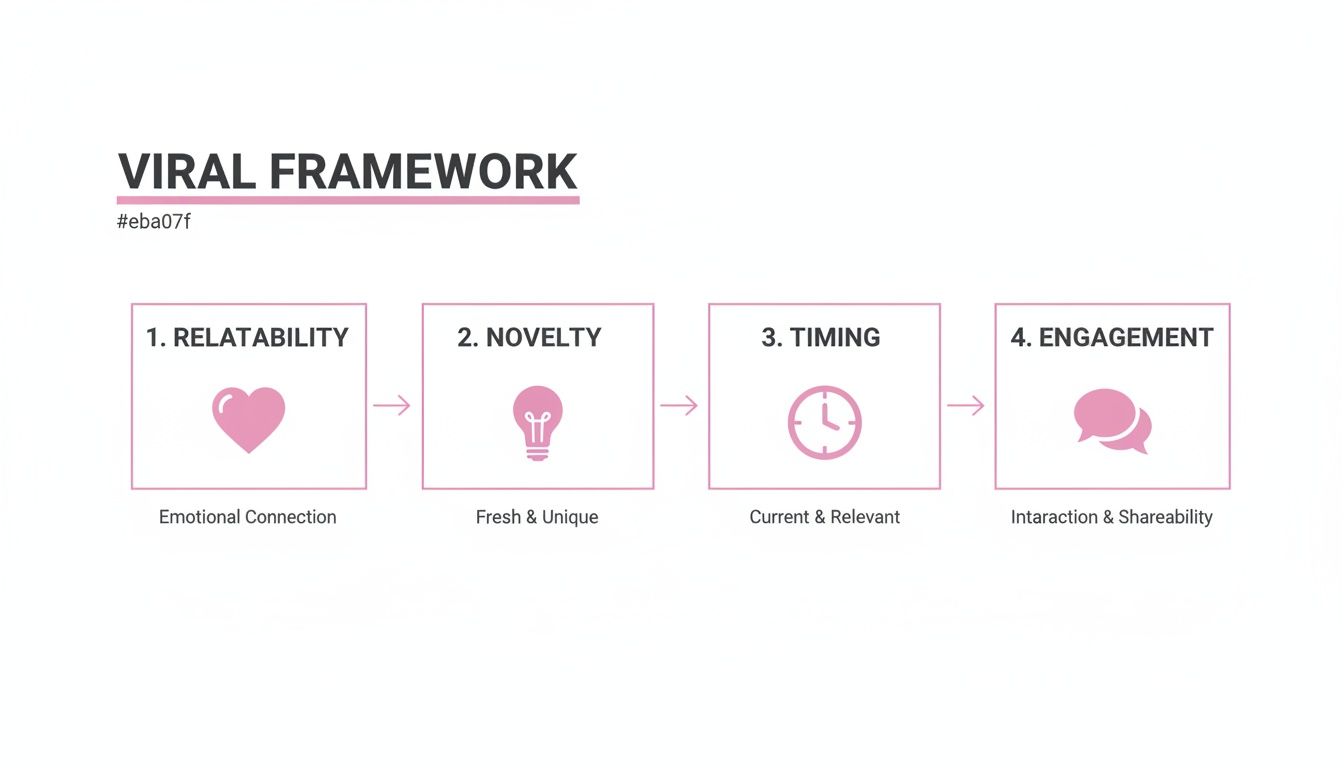
This doesn't happen by accident. It's the result of mastering four key pillars that work in tandem. When a video nails all four, it kicks off a powerful chain reaction. Someone watches, feels a connection, hits share, and the platform’s algorithm notices, pushing your content to an even bigger audience. And the cycle repeats.
This intentional approach is what separates the pros from those just hoping for a lucky break. It’s about baking shareability right into the DNA of your video from the very beginning.
The Four Pillars of Virality
Short-form video is, without a doubt, the best format for this. Think about it: projections show that video content will soon make up a staggering 82% of all internet traffic. The platforms reflect this shift. For instance, according to data from Statista, users spent an average of 95 minutes per day on TikTok in 2023, showcasing the immense opportunity for engagement.
Let's break down the four pillars that form the foundation of this framework.
Below is a quick overview of the four core components every viral-worthy video needs. Understanding how they interact is the first step toward creating content that travels.
The Four Pillars of Viral Video Content
| Pillar | Description | Practical Example |
|---|---|---|
| Relatability | The content strikes a universal chord or taps into a shared experience, making viewers think, "That's so me." | A video showing the struggle of getting out of a warm bed on a cold Monday morning. |
| Novelty | It presents a familiar idea in a surprising, fresh, or unexpected way that grabs and holds attention. | A time-lapse of someone building an intricate LEGO version of a famous landmark, but with a comedic twist at the end. |
| Timing | The video is released when the topic is culturally relevant, trending, or seasonally appropriate. | Posting a clever "Game of Thrones" meme right after a new "House of the Dragon" episode airs. |
| Engagement | The content is designed to prompt a reaction—a comment, share, save, or stitch—fueling algorithmic reach. | A video that ends with a controversial question, like "Is pineapple on pizza a crime? Settle the debate in the comments." |
Each of these pillars builds on the last, creating a powerful flywheel effect that can send your video's reach into the stratosphere.
For a deeper look into the fundamentals of what makes content shareable, this guide on how to create viral videos that get noticed is a great resource.
Now, let's dive into how you can put each of these pillars into action.
Mastering The Art Of The Scroll-Stopping Hook
In the world of short-form video, you don't get a few minutes to make your case. You don't even get ten seconds. You have, at most, three seconds. If you haven't snagged someone's attention by then, they're gone. Forever. This is why the scroll-stopping hook is the single most critical element in the viral video equation.
A great hook isn't just about being loud. It's a calculated psychological jab designed to break someone's mindless scrolling trance. You do this by showing them something unexpected, asking a question they can't ignore, or teasing a shocking outcome right at the top. The goal is to create an immediate "information gap" that the viewer feels a deep, primal need to close.
Look at a master like MrBeast. His videos explode from the very first frame with an insane premise, like "I just built a real-life chocolate factory!" He doesn't build up to it; he shows you the unbelievable result first. It makes it impossible to look away because your brain immediately asks, how on earth did he do that?
The Psychology Of The Pattern Interrupt
On social media, the default pattern is the endless, predictable scroll. Your hook needs to be the jolt that shatters that pattern. It's a technique called a "pattern interrupt," and it's designed to break a person's typical behavior.
Here’s how you can create one:
- Auditory Interrupts: Use a jarring sound effect, a sudden moment of silence, or a blast from a high-energy trending audio. It’s an instant signal that something different is happening here. For example, the viral "Oh No" sound effect from the song "Remember (Walking in the Sand)" is instantly recognizable and signals something is about to go wrong.
- Visual Interrupts: Kick things off with a super-fast montage, a weird camera angle, or a stunning visual "reveal" that defies what the viewer expects to see. Think of those quick, frantic zooms you see on TikTok—that's a raw, energetic visual interrupt.
- Cognitive Interrupts: Start with a controversial statement or a question that challenges a deeply held belief. A fitness video that opens with, "Everything you think you know about losing belly fat is a lie," is a perfect example.
Key Takeaway: The first three seconds literally decide your video's fate. A high "hook rate"—the percentage of people who watch past that crucial mark—tells the algorithm your content is engaging and deserves to be pushed to more people.
Actionable Hook Formulas That Actually Work
Instead of just winging it, you can lean on proven formulas that are basically cheat codes for generating curiosity.
Take the "Shocking Result First" method. Let's say you're making a video about transforming a messy garage. The boring way is to show the cluttered "before" shot. The viral way? Show the stunning, perfectly organized "after" shot for just two seconds with the text: "I turned this disaster into a dream garage in one weekend." You immediately prove the value, and now everyone wants to see the satisfying journey to get there.
Here are a few more formulas to add to your toolkit:
| Hook Formula | Description | Why It Works |
|---|---|---|
| The Provocative Question | Ask a question that hits a common pain point. (e.g., "Are you still making this mistake with your money?") | It instantly personalizes the content and promises a solution the viewer can use in their own life. |
| The "You Won't Believe" Statement | Lead with a bold, almost unbelievable claim. (e.g., "This one trick got me 100,000 followers in 30 days.") | This creates massive intrigue and frames your video as the keeper of a valuable secret. |
| The Story Teaser | Drop the viewer right into the middle of a dramatic story. (e.g., "And that's how I ended up stranded in the desert…") | Humans are hardwired for stories. Starting mid-action forces them to keep watching to figure out what happened. |
To really dig into this, you should study proven strategies on how to start a YouTube video and capture attention in those first critical seconds. This isn't just a "nice to have"—it's the foundation of everything that comes next.
Crafting Content People Can't Help But Share
A great hook buys you three seconds. The actual substance of your video is what earns you the share. If you want a video to truly take off, you have to create something that resonates so deeply with people that they feel an almost physical need to pass it on.
This isn't about luck. It's about intentionally tapping into core human emotions.
Content that makes us feel something—whether it's gut-busting laughter, genuine awe, or even a little righteous anger—is what gets shared. We share things that reflect who we are, make us look good, or help us connect. Your job is to bake that emotional payload directly into your video’s DNA.
Tap Into Universal Emotional Triggers
Think about the last video you shared. Chances are, it made you feel something. You don't need a Hollywood budget; you just need to understand what makes people tick. The goal is to make someone's immediate reaction, "Oh, my friends have to see this."
Here are the heavy hitters:
- Humor: Laughter is the ultimate social glue. A simple skit about the universal struggle of assembling IKEA furniture can get millions of shares because it's painfully relatable and hilarious.
- Awe and Inspiration: We love to be amazed. Think of a time-lapse of an incredible street artist at work or a story of someone overcoming insane odds. This content makes us feel uplifted and optimistic.
- Deep Relatability: This is that powerful "that is so me" moment. A video that perfectly nails the specific anxiety of a Sunday evening or the pure joy of finding a forgotten $20 bill in a coat pocket creates an instant bond.
- Outrage or Controversy: Tread carefully here, but content that challenges a common belief or shines a light on an injustice can spread like wildfire. It taps into our desire to stand for something and join a larger conversation.
Use Storytelling to Frame Your Message
Even in a 30-second clip, a story gives your content a satisfying beginning, middle, and end. It makes your message stick. Two classic frameworks are gold for short-form video.
First up is the Problem-Agitate-Solution (PAS) model. It's perfect for educational or how-to content.
- Problem: Kick things off with a pain point your audience knows all too well. (e.g., "Tired of your houseplants always dying on you?")
- Agitate: Twist the knife a little. Remind them why it's so frustrating. (e.g., "You spend all this money and time just to watch them wither away.")
- Solution: Ride in with the simple, clear answer. (e.g., "Here's the one watering trick you've been missing.")
This structure works because it validates the viewer's frustration before delivering the payoff. It makes them feel seen, and they'll want to share that solution with friends who have the same problem. For a deeper dive, check out our guide on how to create compelling short-form content.
The second is a simplified Hero's Journey. Here, someone (the hero) overcomes a challenge and is transformed. A fitness creator showing their year-long transformation isn't just posting before-and-after pics; they’re telling an inspiring story of struggle, dedication, and triumph. That's a narrative people want to be a part of.
Authenticity Is Your Greatest Asset
In a feed full of slick ads and impossibly perfect influencers, raw authenticity is magnetic. It's why behind-the-scenes footage and "day in the life" videos often outperform polished productions. Peeling back the curtain builds a level of trust and connection that money can't buy.
The data backs this up. A 2023 report by Sprout Social found that 33% of consumers believe authenticity is what makes a brand's content stand out on social media, second only to engagement.
Brands and creators who lean into transparency—even when it's not perfect—are the ones winning right now. Don't be afraid to show the real, unpolished version of yourself or your work. That's the stuff that truly connects.
Working With the Algorithm, Not Against It

You can craft the most brilliant video in the world, but if you don't play by the platform's rules, it’s going to get lost in the noise. It’s a hard truth, but going viral means treating the algorithm as your most important viewer.
Think of it like this: your content is the product, and the platform’s algorithm is your distribution partner. You have to package your video in a way that makes it dead simple for the algorithm to understand who it's for and why it's worth showing to millions of people.
The good news? The core signals are surprisingly consistent across TikTok, Instagram Reels, and YouTube Shorts. They all just want to keep people on their app for as long as possible. Your job is to create content that helps them do that.
Decoding the Signals That Matter
At the heart of every short-form video algorithm are two metrics that carry the most weight: watch time and completion rate. If viewers stick around for your entire 15-second clip, you’ve hit a 100% completion rate—a massive green flag for the algorithm. If they watch it again, your completion rate climbs over 100%, which is pure gold.
But passive watching isn't enough. The algorithm is also scanning for active engagement signals that show people are genuinely enjoying the content.
These are the big three:
- Shares: This is arguably the most powerful signal. When someone sends your video to a friend, they're giving it a personal endorsement. The algorithm loves this.
- Comments: A buzzing comment section means your video is sparking a conversation. It’s creating a community experience right there on the platform.
- Saves: A save tells the algorithm your content is so valuable or entertaining that people want to come back to it. It’s a bookmark for quality.
Here’s how this plays out: A creator posts a 20-second video sharing a quick hack for cleaning sneakers. Because it's short and to the point, most people watch the whole thing (high completion rate). It's genuinely useful, so they hit the save button. They also tag friends in the comments who need to see it, racking up shares. The algorithm sees all these positive signals and starts pushing the video to a much wider audience.
Your Pre-Publish Optimization Checklist
Before you even think about hitting that post button, run through this quick technical checklist. These aren't just creative suggestions; they're strategic moves to give your video an immediate advantage right out of the gate.
Use Trending Sounds—But Do It Right
Trending audio is a distribution shortcut, plain and simple. Platforms often push content using popular sounds to users who have already engaged with that audio. A recent study on TikTok trends confirmed that jumping on a trending song is one of the fastest ways to land in front of new audiences. But don't just slap any popular song on your video. Make sure the audio's vibe actually fits your content and enhances the story.
Master Your Hashtag Game
Hashtags aren't just for decoration; they’re powerful categorization tools. They help the algorithm quickly understand your video's topic and serve it to the right people.
A solid strategy uses a mix of three types:
- Broad Hashtags: Think high-volume tags like
#comedyor#food. - Niche Hashtags: These target specific communities, like
#booktokor#diyprojects. This is where you find your people. - Trending Hashtags: These are tied to current events, challenges, or memes.
Write Captions That Start a Conversation
Your caption is a direct line to your audience and another key signal for the algorithm. Ditch the boring descriptions. Instead, use the caption to prompt engagement. Ask a direct question, state a controversial (but relevant) opinion, or create a "fill-in-the-blank" prompt. Your goal is to get people talking in the comments.
Know the Platform-Specific Quirks
While the core principles are the same, each platform has its own personality. Nailing these small differences can give you a serious edge.
| Platform | Key Focus | How to Optimize |
|---|---|---|
| TikTok | Community & Trends: The "For You Page" runs on what's hot within niche communities and what sounds are blowing up right now. | Go all-in on trending sounds and use community-specific hashtags. This is how you get discovered here. |
| Instagram Reels | Aesthetics & Shareability: Reels tends to favor more polished, visually appealing content. The algorithm also heavily weighs shares to DMs. | Focus on creating clean, beautiful visuals and use captions that explicitly encourage viewers to share the video with friends. |
| YouTube Shorts | Search & Longevity: Shorts gets a huge boost from YouTube's powerful search engine. A video can suddenly take off weeks or months later if it matches what people are searching for. | Write clear, keyword-rich titles and descriptions. Think about what terms people would use to find your content and use them. |
At the end of the day, winning with the algorithm isn't about gaming the system. It's about clearly communicating your video's value so the platform can connect it with the audience that's going to love it. Get these technical details right, and you give your creative work the best possible shot at being seen by millions.
How Smart Tools Scale Your Video Production
Consistency is the real engine behind viral growth. But let's be honest—it’s also a one-way ticket to burnout. Juggling trends, keeping the algorithms happy, and pushing out quality content on every platform is a massive undertaking. The old-school, manual editing workflow just can't keep up.
The secret to staying in the game long enough to actually go viral isn't about working harder. It's about working smarter. Moving from a soul-crushing, time-sucking process to an efficient, tool-driven one isn't a luxury anymore. For anyone serious about making a real impact with video, it's a strategic must.
This is exactly where AI-powered video platforms come in, turning your content creation bottleneck into a high-speed production line.
From Manual Grind To Automated Flow
Think about the typical creator's day. They spend hours scrubbing through a long podcast recording, trying to find a single good moment. Then comes the painful process of transcribing it and animating captions word by word. After all that, they still have to resize and reformat that clip for TikTok, then Reels, then Shorts. It's a mind-numbing cycle that can burn a whole day for just a couple of videos.
Now, imagine a different way. That same creator uploads their long-form video, and an intelligent tool instantly flags the most engaging, shareable segments. It generates perfectly synced, stylish captions in seconds, snips out the awkward pauses, and reformats the final clips for every social platform with a single click.
The difference is stark. Instead of spending 90% of their time on repetitive editing tasks, the creator can now dedicate that energy to what truly matters—coming up with the next great idea.
This isn't just about saving a few hours. It’s about increasing your "at-bats." The more high-quality experiments you can get out the door, the better your chances of hitting a home run. The right tech allows you to test more hooks, different formats, and new ideas without burning out or letting quality slide.
Your Strategic Advantage In The Content Race
In the world of short-form video, speed is your biggest competitive advantage. Today, a staggering 91% of businesses are using video as a core part of their marketing strategy. To cut through that noise, creators and marketers are getting help from AI, with 75% already using it for things like content creation and editing. You can see a full breakdown of these video marketing statistics on Vidico.com.
This is where a platform built for speed and scale gives you an undeniable edge. Unlike traditional editing software which requires manual keyframing and separate project files for each format, automated platforms streamline the entire process from clip selection to final export.
The Old Way vs. The Smart Way
| Task | Traditional Workflow (Manual) | Smart Workflow (Automated) |
|---|---|---|
| Clip Sourcing | Hours of scrubbing through footage to find good moments. | AI suggests the most viral-worthy clips automatically. |
| Captioning | Tedious, manual transcription and keyframing. | Instant, accurate captions with animated styles. |
| Resizing | Separate projects and exports for each platform format. | One-click resizing for TikTok, Reels, and Shorts. |
| Output | A handful of clips per day, leading to slow growth. | Dozens of clips ready to post, enabling rapid testing. |
This refined workflow frees you up to think about strategy instead of getting lost in the technical weeds. The ability to quickly spin up multiple versions of a single idea is a huge unlock. You can test one clip with bold, flashy captions and another with a cleaner, more subtle style to see what your audience actually connects with.
This kind of rapid-fire experimentation used to be impossible for solo creators or small teams. If you feel like your process is holding you back, an automatic video editing software can be the key to reaching a new level of productivity and creativity. By handing off the most tedious parts of video production, you're not just making content faster—you're building a sustainable system for growth.
Common Questions About Making Videos Go Viral

Even with a solid playbook, you’re bound to hit a few roadblocks or second-guess your strategy. It happens to everyone. Let's tackle some of the most common questions from creators trying to crack the viral code.
Think of this as your go-to cheat sheet for those "am I doing this right?" moments.
How Long Should a Video Be To Go Viral?
There's no single magic number, but the data definitely points to a sweet spot. On platforms like TikTok and Instagram Reels, short and punchy reigns supreme. You should generally aim for something between 15 and 45 seconds.
Why? Because shorter videos make it much easier to get a high completion rate, and that's a huge signal to the algorithm that your content is sticky. For example, a 15-second "life hack" video is far more likely to be watched to completion than a 3-minute tutorial on the same topic.
That said, the story should always dictate the length. If you've got a killer life hack that takes seven seconds to show, then your video is seven seconds long. On the other hand, if a story needs 60 seconds to build suspense and deliver a real payoff, don't chop it down just to hit an arbitrary number.
The real key is to be absolutely ruthless in your edit. Every single second has to earn its place. Check your analytics—if you see a massive viewer drop-off at the 10-second mark on most of your videos, that’s your audience telling you to get to the point faster.
How Important Are Hashtags and Trending Sounds?
They're not just important; they're essential distribution tools. If you use them right, they can be a massive multiplier for your reach.
Trending sounds, in particular, are like hopping on a rocket ship. The platforms are already pushing that audio to millions of people who are actively engaging with it. A TikTok study even found that nearly 50% of content discovery happens because users want to "learn something new," and popular sounds are a huge gateway for that. A practical example is a real estate agent using a trending song to do a quick tour of a new listing, making the content more engaging and discoverable than a silent tour.
Hashtags work a bit differently but are just as crucial. They're how you tell the algorithm who to show your video to. A smart strategy uses a mix of tags:
- Broad Tags: Think high-volume stuff like
#comedyor#travel. - Niche Tags: These connect you to tight-knit communities, like
#booktokor#teacherlife. - Trending Tags: Jump on these when they're tied to current events or a platform challenge.
The most crucial factor is relevance. Slapping a trending sound on a completely unrelated video just confuses people, kills your engagement, and tells the algorithm your content is a poor fit for that audience. It does more harm than good.
Do I Need Expensive Equipment for a Viral Video?
Absolutely not. In fact, some of the most viral videos you see were shot on a regular smartphone. On platforms like TikTok, audiences crave authenticity. A raw, in-the-moment clip often feels more genuine and relatable than a slick, over-produced video. For example, the viral "Corn Kid" video was a simple, unpolished interview shot on a phone, but its authenticity charmed millions.
Instead of obsessing over a fancy camera, pour your energy into two things that actually make a difference to the viewer experience: good lighting and clear audio.
You don’t need a pro lighting kit—just face a window for some great natural light. And a simple lavalier mic that plugs into your phone will make your audio sound ten times better than the built-in mic.
People will forgive a shaky hand, but they won’t sit through a video where they can't see what's happening or hear what you're saying. Your creativity and understanding of the platform are your most valuable assets, not your gear.
How Often Should I Post To Increase My Chances?
Consistency beats frequency, but on algorithm-first platforms, posting 1-3 times per day is a proven way to light a fire under your growth.
Think of it as having more at-bats. The more you post, the more chances you have for one video to really connect and take off. It also shows the algorithm that you're a serious, active creator, which can earn you a little extra favor in the feed.
More importantly, posting often gives you a ton of data. You learn faster what hooks work, which topics resonate, and what formats get shared. It's a rapid feedback loop. For example, a food blogger posting once a day can quickly learn that their "quick breakfast" videos get 10x more engagement than their "complex dinner" videos.
But here’s the caveat: never sacrifice quality for quantity. A single fantastic video is infinitely better than three rushed, mediocre ones. The real goal is to find a sustainable rhythm that lets you create great content without burning yourself out. For some, that's three times a day. For others, it's once. Find what works for you and stick to it.
Ready to stop the manual grind and start scaling your video production? Our platform uses AI to help you turn long-form content into dozens of viral-ready short clips in minutes, not hours. Automate captions, find the best moments, and get your content in front of more people, faster.