Looking to take your content into the German market? You're tapping into a potential audience of over 100 million native speakers. But breaking into this market successfully means going beyond basic subtitles. It's about crafting an experience that feels truly native, builds genuine trust, and gets people to actually pay attention. Thankfully, the tools and workflows available today make this easier and more affordable than ever.
Why German Audio is a Game-Changer for Growth
For any creator or business with an eye on expansion, the German-speaking world is a massive opportunity. We're talking about Germany, Austria, and Switzerland—a powerful economic region with a huge, digitally savvy audience. But if you think slapping on some German subtitles is enough to win them over, you might want to think again.
Let's be real: people often consume content on the go or while doing something else. Audio is what truly connects and holds their attention. When you provide a dedicated German audio track, you're not just translating words; you're ensuring your message lands exactly as intended, creating a professional and immersive experience that subtitles alone can't match.
Here's what a full audio translation really brings to the table:
- Build a Real Connection: When someone hears your content in their own language, it just clicks. It builds an immediate sense of familiarity and trust, making your brand feel less like a foreign entity and more like a local authority.
- Boost Your Engagement: A recent study by CSA Research found that 76% of online consumers prefer to buy products with information in their native language. For video, this is even more critical. For instance, an e-learning company that added German audio to its top 10 tutorials saw a 60% increase in watch time from Germany, Austria, and Switzerland.
- Stand Out from the Crowd: Most of your competitors will probably stop at subtitles. By offering a full audio experience, you're sending a clear signal about your commitment to quality and to the German market. It's a powerful differentiator.
This isn't just about a word-for-word swap, either. It’s about cultural nuance. A literal translation of an English idiom like "bite the bullet" would come out as "beiß in die Kugel" in German, which would leave any native speaker completely confused. The actual German equivalent is "in den sauren Apfel beißen" (to bite into the sour apple)—it captures the same feeling of enduring something unpleasant.
The right tools can help you navigate these cultural subtleties, turning a simple translation into an authentic localization. This is how you transform a standard video into a serious tool for international growth.
Nailing Your German Audio: A Practical Workflow
Getting a polished translation from English to German audio isn't magic; it's a process. And it all starts with the quality of your original English recording. Think of your source audio as the foundation of a house—if it's shaky, everything you build on top of it will be, too.
This isn't just about swapping words. It's about creating a genuine connection with a new audience. The path from your English video to real growth in the German market is more direct than you might think.
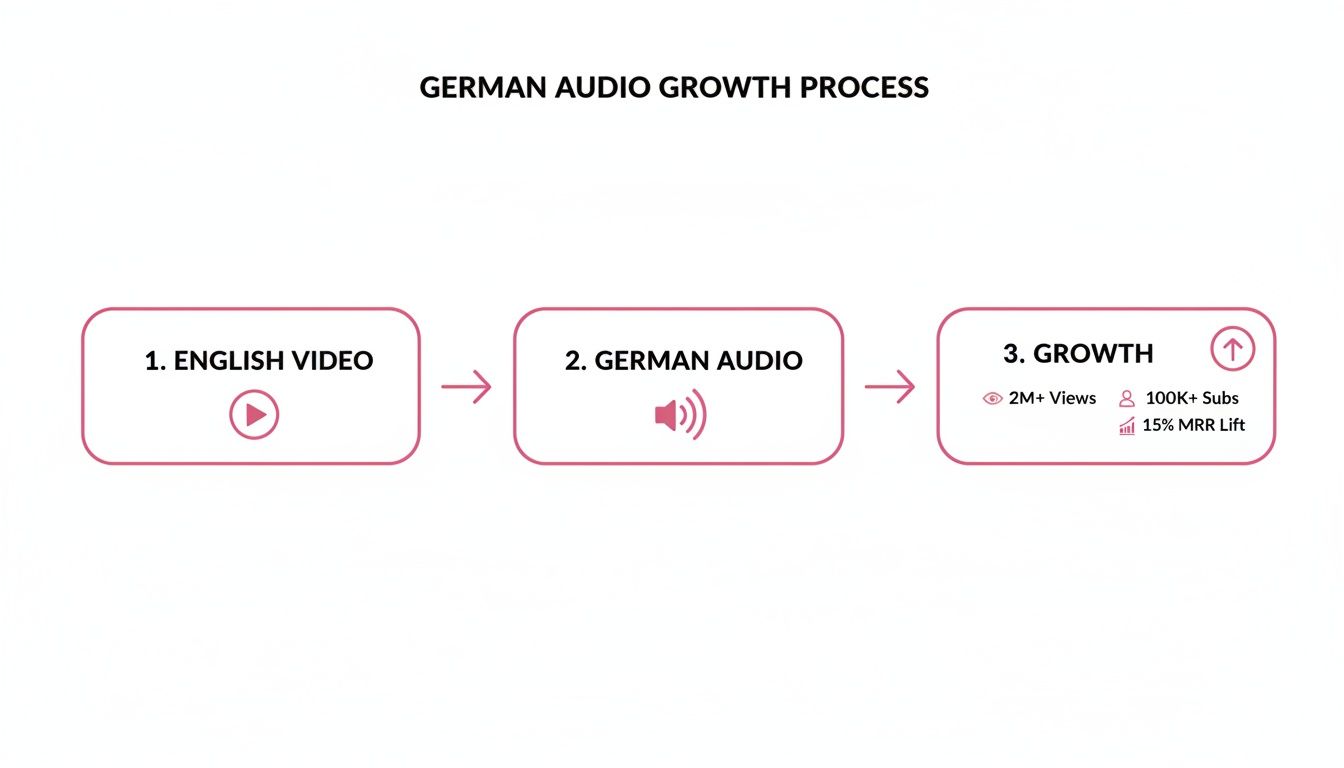
As you can see, this isn't just a creative exercise. Turning your English content into high-quality German audio is a strategic play that directly drives audience growth and engagement.
Get Your Source Material Ready
Before a single word gets translated, you need to prep your English audio. This means getting rid of as much background noise as you can, using a decent microphone, and speaking clearly. If you're starting with a video, the first practical step is to extract audio from video into a clean, workable file.
Many modern platforms can also automatically zap filler words like "um," "ah," and "you know." This one feature is a game-changer. It cleans up the raw material so your transcription—and the final translation—is far more accurate from the get-go.
Key Takeaway: A messy English original will always lead to a messy German translation. Taking the time to clean up your source audio saves you a world of headaches and rework down the line.
From Spoken Words to a German Script
With your audio file prepped and clean, it's time for transcription. Modern AI tools can listen to the English audio and spit out a written script with impressive accuracy. This text file is what you'll use for the actual translation. If your content is on YouTube, you can learn how to get a transcript from a YouTube video to make this part even faster.
Once you have that clean English transcript, machine translation models can take over. These aren't your old, clunky translators; they're trained on vast amounts of data to produce German text that’s not just grammatically sound but also understands the context. What used to take days of manual work can now be done in minutes.
Creating the German Audio
Now for the fun part: turning that German script into a voice. You've basically got two options here: an AI-generated synthetic voice or a professional human voice actor. Each has its place, and the right choice really depends on your budget, timeline, and what you're trying to achieve.
The demand for this is exploding. The global language services market reached a value of $60.7 billion in 2022, with Europe accounting for a massive 49% of that. Germany is a huge piece of that pie, where localized videos can pull in 30-50% higher viewership.
So, which path should you take—AI or human? Let's break it down.
AI Voiceover vs. Human Dubbing: A Quick Comparison
Choosing between an AI voice and a human actor is often a balancing act between speed, cost, and the need for emotional punch.
Here's a straightforward look at how they stack up.
| Factor | AI-Powered Synthetic Voiceover | Professional Human Dubbing |
|---|---|---|
| Speed | Incredibly fast. You can often generate the final audio in just a few minutes. | Much slower. The process involves casting, recording, and editing, which can take days or even weeks. |
| Cost | Very budget-friendly, making it a great option for projects of any size. | A significant investment. You're paying for studio time, sound engineers, and professional talent. |
| Consistency | Delivers a perfectly consistent tone and pace every single time, across all your content. | Performance can have slight variations between recording sessions or if you switch voice actors. |
| Emotional Nuance | Excellent for narration, tutorials, and direct communication. Can struggle with deep emotion or sarcasm. | Unbeatable for conveying complex emotions, brand personality, and subtle vocal cues. |
For many projects, AI voices are the clear winner. Imagine a marketing agency wanting to turn an English webinar into a dozen German social media clips. Using AI, they can test different versions with the German audience almost instantly, without a huge upfront cost. This makes it possible to experiment and find what truly connects.
Selecting the Right Audio Translation Tools
Choosing the right technology can be the difference between a clunky, time-sucking process and a smooth, professional workflow for your German audio translations. The market is packed with options, but if you know what to look for, you can quickly find a tool that genuinely works for you.
Your first filter should be accuracy. Look for platforms that use high-quality AI models specifically trained for English-to-German. The best systems today can grasp context, which is absolutely vital for translating idioms and cultural nuances correctly. You need a tool that ensures your message actually lands the way you intended it to.
But the translation engine is only one piece of the puzzle. The biggest efficiency boosts come from features that automate the tedious manual work that surrounds the translation itself.
Core Features That Drive Efficiency
We’ve all been there: using one tool for transcription, another for translation, and a third to sync the audio. This kind of fragmented workflow is a recipe for frustration. You end up wasting so much time exporting, importing, and re-syncing files, and every single one of those steps is a chance for something to go wrong.
An integrated, all-in-one platform is just a much smarter way to work. It handles everything—from the initial transcription to the final audio generation—all in one place. Unlike competitors that often require you to juggle separate tools, platforms like ours are built to handle the entire process in a single, seamless flow, which significantly reduces errors and production time. When you're weighing your options, it's worth taking the time to research the best AI voiceovers to understand what’s possible for creating high-quality spoken content.
To really streamline your process, zero in on these capabilities:
- Integrated Transcription and Translation: The system should take your English audio, transcribe it, and then translate the text into German automatically. No app switching required.
- Filler Word Removal: A good tool will automatically spot and remove all the "ums" and "ahs" from your original audio. This cleans up the transcript and gives you a much more precise translation.
- Active Speaker Detection: This is a lifesaver for interviews or dialogue. The feature identifies who is speaking and when, which is essential for creating accurate conversations with properly assigned voices.
When you bring these features together in one place, you can make your entire content creation process up to 10x faster. It completely cuts out the manual drudgery of moving files around, letting you focus on the creative side of localizing your content.
The ROI of an Integrated Platform
Moving from a collection of different tools to a single platform isn't just about making your life easier—it’s about your return on investment. The speed you gain from an integrated system has a direct impact on how quickly you can get your content in front of new audiences.
Here's a practical example: a media company producing short-form educational videos was struggling with their international production timelines. Their process involved a transcription service, a freelance translator, and a separate voiceover tool. By switching to a single, unified platform, they cut their production cycle for German-language videos from four days to under an hour, a massive 97% reduction in turnaround time.
That wasn't just a time-saver. It meant they could test more content, react faster to trends in the German market, and ultimately drive more revenue. Their story is a perfect example of how the right tool doesn’t just make things faster—it opens up completely new opportunities.
Perfecting Your German Audio and Video
Getting the words right is just the start. The real magic in translating English audio to German happens in the final polish—this is where you turn a technically correct translation into an experience that feels completely natural to a German audience.
It all begins with adapting your script for cultural resonance. A literal, word-for-word translation is a classic rookie mistake, especially with idioms. For instance, the English phrase "it's not rocket science" doesn't work when translated directly. A German speaker would say, "es ist kein Hexenwerk," which literally means "it's not witchcraft." These are the small, yet vital, tweaks that make your content relatable instead of awkward.
Getting the Timing Just Right
With a culturally adapted script in hand, your next hurdle is timing the audio. German sentences often run longer than their English equivalents, and this can throw your entire production out of whack. A new audio track that doesn't match the speaker's lip movements or on-screen gestures is a dead giveaway of a cheap dub and can be incredibly distracting for the viewer.
The trick is to meticulously adjust the pacing of the German voiceover. This might mean speeding up a few words here, or adding a strategic pause there, all to ensure the audio lines up with the important visual cues. If you want to dive deeper into this, there are great techniques to sync audio and video that can help you achieve a truly seamless result.
A perfectly timed audio track should be invisible. The audience won't notice it's there—it will just feel right. This is what separates amateur work from professional localization.
Designing Subtitles That Actually Help
Even if you have a flawless German audio track, don't skimp on captions and subtitles. They're critical for accessibility and grabbing attention, especially since so many people watch videos with the sound off. Good subtitles can make a massive difference in comprehension and how long people stick around.
Don't just settle for the default white text on a black bar. Tailor your subtitles to fit your brand's look and feel.
- Font Choice: Pick a font that’s clean and easy to read but also matches your brand’s personality.
- Color and Contrast: Your colors should pop against the video background without being obnoxious. Sometimes a simple, semi-transparent background box behind the text is all you need.
- On-Screen Placement: Be mindful of where you place the captions. You don't want them covering up someone's face or a key product shot.
Modern AI has made this entire workflow so much more manageable. The speech-to-speech translation market is expected to reach USD 1.15 billion by 2030, a boom driven by tools that can now hit over 95% accuracy for language pairs like English and German. As Mordor Intelligence highlights, this growth shows just how many creators are turning to AI to save time and cut costs.
Think about it: a social media clip with clunky, literal translations and mismatched timing looks unprofessional. But by localizing the nuances of the language and perfectly syncing the audio, you create a polished video that genuinely connects with your German-speaking viewers. It’s these finishing touches that make all the difference.
How to Scale Content Localization with Automation
When you're trying to consistently reach a German audience, manually translating and dubbing every single piece of content just isn't realistic. It's a massive time sink. This is where automation, especially when powered by an API, completely changes the game.
By plugging translation english to german audio capabilities directly into your workflow, you can turn a single long-form video into dozens of perfectly dubbed short clips for social media with almost no hands-on effort.
It's not just about moving faster; it's about building a content engine that can actually scale. An API can handle the whole nine yards—transcription, translation, voice generation, and even video clipping—letting you pump out a steady stream of localized content. The benefits of using an API for video repurposing are huge, giving you the power to build custom pipelines that fit your specific needs.
Building a Custom Content Pipeline
Think about a SaaS platform looking to expand its footprint. By integrating a translation API, they could suddenly offer automated video localization as a new premium feature. A customer could upload an English product demo and, within minutes, get back a German-dubbed version ready for their marketing campaigns in Europe. What was once a complex manual service becomes a scalable, automated product.
The real power of automation is its ability to maintain consistent quality at any volume. Whether you're creating one video or one hundred, the process, tone, and output remain the same, strengthening your brand identity in new markets.
This approach plugs directly into a market that's blowing up. The translation technology market in Germany alone is projected to grow at a compound annual growth rate (CAGR) of 13.5% through 2032.
For creators and businesses, this is a clear signal. Localizing your content can boost conversion rates by as much as 40% in the DACH region. If you want to dive deeper into the numbers, check out GM Insights' analysis of this growing market.
The Developer Advantage
For a developer, a solid API opens up a world of possibilities. You could build a custom app that automatically pulls new episodes from a podcast feed, translates the audio into German, and then pushes the dubbed versions out to various social media platforms.
This kind of integration makes developer tools a central part of international growth. It clears out the operational roadblocks that have traditionally kept businesses from expanding globally, making it possible to tap into the lucrative German market efficiently and at a scale that was previously unimaginable.
Got Questions? We've Got Answers
Diving into the world of translation english to german audio usually brings up a few common questions. Let's clear those up so you can move forward with confidence.
Just How Good Is AI English to German Audio Translation These Days?
Honestly, it's remarkably good. Modern machine translation for a widely-spoken language pair like English to German often hits accuracy rates well over 95%. The AI has gotten much better at understanding context and nuance, avoiding the awkward, literal translations that plagued older tools. The synthetic voices have also come a long way—they sound far more human and less like a GPS navigator from 2005.
That said, for content where the emotional tone is everything, like a deeply personal story or a critical brand message, nothing beats a final polish from a human. Think of AI as the incredibly efficient first draft, and a human expert as the one who adds that final, perfect touch.
What's the Absolute Fastest Way to Translate My Video's Audio?
If speed is what you're after, an all-in-one AI platform is your best bet, hands down. These tools handle the entire process from start to finish, all under one roof.
You're essentially condensing a multi-day, multi-person job into a few clicks. The workflow typically looks like this:
- Automatic Transcription: The platform listens to your English audio and converts it to text.
- Machine Translation: That text is instantly translated into a German script.
- Voice Generation: An AI voice creates the new German audio track.
- Video Syncing: The new audio is automatically lined up with your original video's timing.
What used to be a tedious, manual process is now something you can knock out in minutes. It's a game-changer for anyone needing to produce localized content consistently and quickly.
Should I Just Use German Subtitles, or Do I Really Need a New Audio Track?
Subtitles are a great starting point, but if you want to truly connect with a German-speaking audience, a dubbed audio track is far more powerful. Think about how people consume content today—often while they're doing something else, like cooking, commuting, or scrolling on their phone. They’re listening more than they’re watching.
An audio track lets your message sink in effortlessly, creating a much more natural and immersive experience. On platforms like TikTok or Instagram Reels where sound is crucial, a German voiceover isn't just a nice-to-have; it's essential for grabbing and holding onto someone's attention in a sea of content.
Ready to stop translating and start localizing your video content the smart way? Swiftia can take your long-form videos and automatically generate dozens of perfectly dubbed, shareable clips for your German audience. See how our AI-powered workflow can help you expand your reach by visiting us at https://swiftia.io.